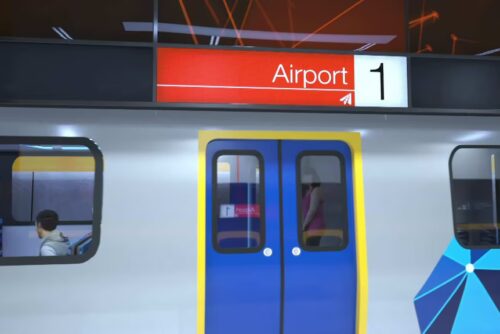
Figure 1: An airport rail line has been proposed since 1970 but construction has only began in 2025.
Melbourne is a city that is marketed as one of the most livable, yet it is without a direct airport train system, and the promised fix keeps delaying further and further away from the future. This is a stark contrast to almost all international cities such as Sydney, Hong Kong and Singapore, where seamless airport to CBD transport has existed for years. The Melbourne airport train line is expected to open by the late 2030’s, which begs the question: how has it taken so long, and what forces have driven this infrastructure nightmare? Is this proposed date another shallow promise that won’t be fulfilled?
Decades of argument have finally produced a plan with dates attached, and its shape explains both the ambition and the delay. The line will branch off the existing network at Sunshine, in Melbourne’s west, a route the state’s own strategic appraisal judged better than the alternatives because it feeds into the Metro Tunnel and pulls regional services into the same corridor. Only three stations are planned: Sunshine, a new stop at Keilor East serving the Airport West precinct, and an elevated station beside the terminals. Trains are meant to run every 10 minutes, with the trip into the CBD taking around half an hour, and more than 30 stations, as far out as Cranbourne and Pakenham, would gain a direct connection to the airport.
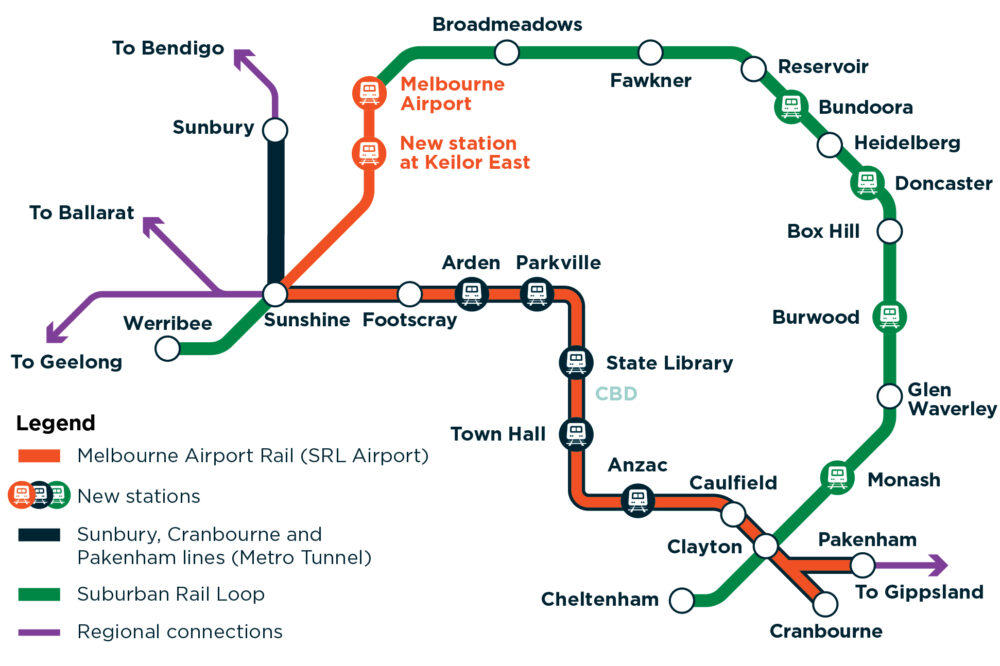
Figure 2: The planned Melbourne Airport Rail route. Source: Victoria’s Big Build, State Government of Victoria
The price has climbed as the timeline has stretched. Canberra now puts the project at $12 billion and is contributing $7 billion, well beyond the $5 billion each government pledged in 2022. Construction began in February 2026, and not on the airport section. Stage one is a $4.1 billion rebuild of the corridor between West Footscray and Albion, adding 6 kilometres of track, two rail bridges, new stations at Tottenham and Albion, and a “superhub” at Sunshine. It will support roughly 8,000 jobs, and it will not be finished until 2030. The airport itself is not due to be connected until late 2033, nine years after the operator and the state finally broke their deadlock over whether the terminus should sit above ground or below.
The 2033 date is a problem because the airport’s road traffic will keep growing in the meantime. Melbourne Airport sits 23 kilometres from the CBD in a city that spent its post-war decades planning around the car, which is why almost all of the nearly 37 million passengers who passed through the terminals last financial year arrived by road. The airport’s draft master plan expects that figure to reach around 75 million a year by 2047, and its third runway, approved in 2024, is scheduled to open in 2031, two years before the first train pulls in. Melbourne will therefore add capacity in the air before it adds any on the ground, and the congestion the rail link is meant to relieve looks set to worsen before it eases.
Perhaps the largest reason as to why one of Australia’s fastest-growing airports still can’t get a train line comes down to a key detail: the Melbourne Airport isn’t public infrastructure, it’s privately owned. Operated by Australia Pacific Airports (Melbourne) under a 50-year Commonwealth lease since 1997, the airport’s largest shareholders are industry superannuation and infrastructure funds, notably IFM Investors, whose stake could climb toward 45 per cent following a 2026 court-ordered sale of Dexus’s holding. APAC’s incentives may very well skew toward ensuring long-term commercial returns rather than accelerating a project that could severely hamper one of their most lucrative revenue streams; car parking and landside transport access fees.
For everyday commuters the costs are noticeable, as locals could see themselves paying anywhere from $17.00 to $85.22 for a slot, and that’s before considering the 18,000 airport workers who are either having to front up paying $79 a day in parking fees or relying on the four bus routes just to get to their shifts. For 2024-25 alone, the ACCC concluded that Melbourne Airport’s gross parking revenue was the highest in the country at $170.4 million, with a comfortable operating profit margin sitting just shy of 60%.
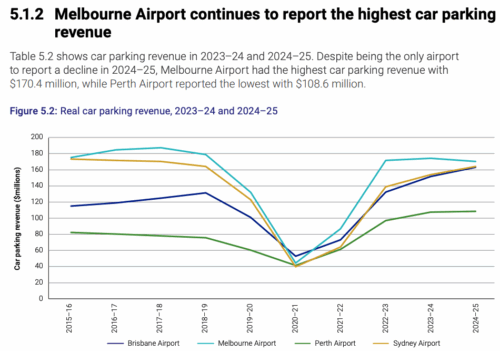
Figure 3: A comparison between Australia’s largest four airports’ car parking revenue
Furthermore, under the ACCC’s monitored ‘landside transport access’ category, Melbourne Airport extracts automated curb side levies that charge $4.50 and $5.07 on every taxi and rideshare pickup, and also holds concession agreements with coach operators like SkyBus. Beyond what’s already telling in the revenue figures, APAC has invested further into growing its traffic inflow capacity with the planned “Naarm Way” construction that has already produced 10 more Uber kerbside bays. Uber and other rideshare operators already contribute a whopping 48.7% to Melbourne Airport’s landside transport access revenue that totalled to $29.7 million across 2024-2025. And if you’re APAC, why deviate from what already boosts your bottom line? It’s increasingly evident that each of Melbourne Airport’s 24,690 car parks will continue to turnover a noticeable profit so long as people are forced into commuting by car, as there simply aren’t any other consistently reliable alternatives. Whether the onus has been on APAC to spearhead the Airport Rail is up to interpretation. One such likened to Melbourne Airport “forgetting about its social licence” and focussing on being a “really good carpark operator”, as quoted from Prime Minister Albanese and Treasurer Tim Pallas back in 2024.
Figure 4: Image showing the sheer size of the Melbourne Airport’s carparks
Disagreement and delay have been synonymous with the airport rail link project ever since the question of “how much will it cost” was first asked in parliament in 1964 by a Victorian MP. Victorian’s have witnessed a pattern of false promises continue to push the project’s timeline further and further back. As early as May 2024, Treasurer Tim Pallas confirmed the project wouldn’t be completed until at least four years past its original 2029 target completion date, which, as of mid-2026, has been amended to 2033. That indecision carries a real cost, as Victoria has already spent at least $67 million standing down and redeploying contractors during the period of delay. It took an approaching federal election for Albanese to commit an extra $2 billion to rebuild Sunshine Station in February 2025, one month before a long anticipated mutual agreement to build the cheaper option of an overland rail connection.

Figure 5: A proposed render for the new “Sunshine Superhub”
Beyond being a logistical nightmare, Victoria is already deep in debt, with net debt forecast to climb toward $199.3 billion by 2029-30. That debt load hasn’t stopped a $150 billion pipeline of ‘Big Build’ megaprojects from consuming the state’s capital budget, several of which are now the subject of a royal commission into corruption and mismanagement. Notably, projects such as The Metro Tunnel and Level Crossing Removal Project have both exceeded their initial budget by more than $4 billion each. Layered on top of these blowouts is the Suburban Rail Loop, whose full scope is projected to cost close to $200 billion over the coming decades, according to Victoria’s own financial reporting. Time is indeed money, and it would appear that the Airport Rail has become a project too politically inconvenient to cancel, yet never quite urgent enough to properly fund and finish. What has continued to be a hamper on the Airport Rail for the last 60 years — the lack of committed capital and budget adherence — is likely to continue for the foreseeable future.
It is important to note that the social demand for this project is driven by tourists, small businesses and locals who occasionally travel, who virtually hold no lobbying power, whilst opposition comes from better-resourced industries such as freeway linked companies and landholders. This is a possible explanation for the ongoing delay for this project.
However, while many are keen for the rail system to be completed, there exist some social barriers and backlash against the project. The Sunshine “Superhub” is a planned upgrade to transform Sunshine into a ‘mini CBD’ due to the planned upgrade to the airport rail link. Local residents Matt Way and Justin Mansfield are enthusiastic about the boost for the local area, though they also noted that a popular local cycling path that many commuters use everyday will be removed due to the project, leaving locals slightly conflicted about the expansion.
This isn’t the first time that touching the western corridor has elicited local anger. During an earlier rural link project, residents of Footscray were given no official notice that their properties would be demolished for rail construction, impacting 26 homes and 84 small businesses. Homeowners had been told that their houses would be acquired, giving them a guaranteed exit. However, a change in transport minister casted uncertainty over the continuation of the project, leaving locals not compensated and not free to leave, at one point having to lobby against the government for the project to go ahead. Previous tension in these areas have made the government cautious when constructing in areas near the airport.

Figure 6: Taxi drivers blocking the main entrance of Tullamarine airport
A key group of people who will not be looking forward to the change in airport transport and taxi and uber drivers, many of whom specialize in airport taxi services. Naturally, it is expected that this group will lose a substantial member of customers. Many members of the Victorian Taxi Association have argued that taxi services are a “valuable and easy earner for Taxi drivers”. Taxi drivers have previously protested at Tullamarine over the Airport’s partnership with Uber, meaning a repeat of this is not off the cards. This appears to be the broader persisting trend across this saga, that opposing people or organizations are simply unwilling to create a short term sacrifice due to stable financial profit.
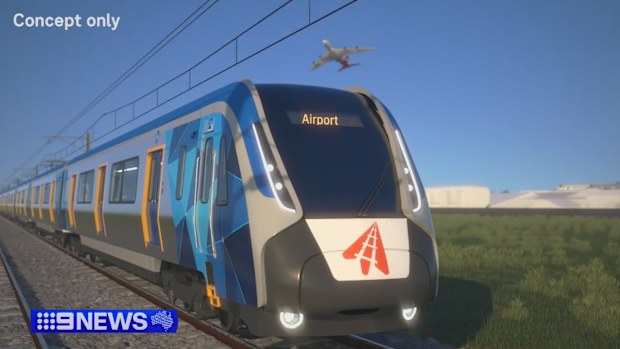
Figure 7: Melbournian travellers will be hoping this concept turns into a reality in the near future.
Taken together, the delays reflect less a single failure than a clash of interests. The airport’s owners have commercial reasons to protect their parking and access revenue, successive state governments have weighed the line against a crowded and costly infrastructure pipeline, and the travellers who would benefit most have had little collective voice. Each position makes sense on its own terms, which is partly why agreement has been so slow to arrive. With construction now under way, whether Melbourne finally gets its airport train is only a matter of whether those competing incentives can stay aligned long enough to finish it.
https://www.abc.net.au/news/2022-09-21/melbourne-airport-above-ground-train-station-business-case/101460384
https://www.abc.net.au/news/2024-02-26/melbourne-airport-road-construction-carparking-passengers/103510696
https://www.abc.net.au/news/2024-05-10/melbourne-airport-rail-link-delayed-again/103823938
https://www.accc.gov.au/about-us/publications/serial-publications/airport-monitoring-reports/airport-monitoring-report-2024-25
https://www.accc.gov.au/system/files/airport-monitoring-report-2024-25.pdf
https://www.afr.com/companies/infrastructure/ifm-s-melbourne-airport-stake-jumped-to-45pc-in-sale-spreadsheet-20260414-p5znp9
https://architectureau.com/articles/stalemate-ends-melbourne-airport-concedes-development-of-above-ground-rail-station/
https://www.australianfrequentflyer.com.au/community/threads/six-million-people-a-year-would-use-train-to-melbourne-airport.50561/page-3#post-837397
https://bigbuild.vic.gov.au/projects/melbourne-airport-rail/future-stages/project-overview
https://centreforaviation.com/news/australian-government-approves-development-plan-for-melbourne-airport-third-runway-1281037
https://engage.vic.gov.au/airportrail-stage1https://infrastructuremagazine.com.au/airport-sets-international-travel-record/
https://www.internationalairportreview.com/melbourne-airport-unveils-20-year-vision-to-support-passenger-growth/2136199.article
https://investment.infrastructure.gov.au/projects/097140-17vic
https://www.jesswilsonkew.com.au/media-releases/2026-03-06-mid-year-financial-report-confirms-victorias-dire-financial-position
https://www.marketingmag.com.au/tech-data/uber-airport-melbourne/
https://www.marketingmag.com.au/wp-content/uploads/2022/04/uber-blockade-820×394.jpg.webp
https://www.melbourneairport.com.au/_assets/be08d7b0-97a1-02f9-2be6-a0c139c3c337/83816f8c-ae99-45ef-ac84-b1bd9a2b440b/APAC_Annual_Report_2025_FINAL.pdf
https://www.melbourneairport.com.au/corporate/ownership
https://www.premier.vic.gov.au/sites/default/files/2026-02/260225-Airport-Rail-Works-Start-%E2%80%93-First-Stop-Sunshine.pdf
https://www.railjournal.com/regions/australia-nz/work-starts-on-melbourne-airport-rail-link/
https://www.sbs.com.au/news/article/melbourne-airport-rail-link-inches-closer/850pmchbh
https://static.ffx.io/images/$zoom_1%2C$multiply_1%2C$ratio_1.777778%2C$width_3840%2C$x_0%2C$y_0/t_crop_custom/c_scale%2Cw_620%2Cq_88%2Cf_auto/23bdc5e985284f07da9c0cdf8f1e582258cd9775
https://www.theage.com.au/politics/victoria/melbourne-airport-accused-of-greed-protecting-parking-revenue-in-rail-link-stoush-20240519-p5jerf.html
https://www.theage.com.au/politics/victoria/right-intent-wrong-projects-dan-s-infrastructure-report-card-20230926-p5e7r3.html
https://www.theb1m.com/video/australias-spending-billions-to-fix-its-melbourne-travel-nightmare
https://www.theguardian.com/australia-news/2026/may/04/victoria-state-budget-2026-surplus
https://www.theguardian.com/australia-news/article/2024/may/19/labor-rank-and-file-tell-victorian-government-to-get-serious-on-long-delayed-airport-rail
https://www.theurbandeveloper.com/articles/melbourne-airport-rail-link-revealed
Sunshine Superhub set to transform Melbourne’s west, but locals divided
The CAINZ Digest is published by CAINZ, a student society affiliated with the Faculty of Business at the University of Melbourne. Opinions published are not necessarily those of the publishers, printers or editors. CAINZ and the University of Melbourne do not accept any responsibility for the accuracy of information contained in the publication.