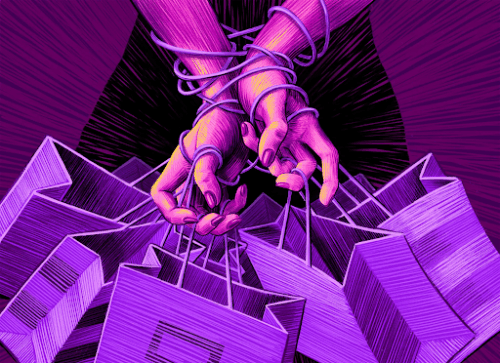
 Figure 1 – How much of our lives do big corporations control? (Goolsbee, 2018)
From the moment you wake up to an algorithmically curated alarm, scroll a feed shaped by unseen incentives, and order breakfast from a platform that tracks your every preference, your day has already been quietly designed for you. This is modern life. And the question worth asking is: how much of it is actually yours? This article examines the many ways consumers have forfeited their freedoms to the rise of big corporations, and what this means for consumers today if corporate power is left unchecked.
The perceived increase in corporate power over the general public and their lives has led to many proclaiming that our modern-day existence has now entered the phase of “late-stage capitalism”, but what does that even mean, exactly? In order to provide a more accurate assessment of how our world is being shaped by corporations, a precise definition of what late-stage capitalism is, as well as its implications, is necessary. The term is most commonly associated with Karl Marx, but in fact was first coined by the German social scientist Werner Sombart in 1925, and further popularised by others in the Marxist school of thought, such as Ernest Mandel in his 1978 work titled “Late Capitalism” (Mandel, 1978). The definition of the term has also varied with the many figures who have applied the term throughout history, but can be summarised into three main characteristics: mass consumerism, extreme wealth disparity, and the immense growth of corporate power (Jameson, 1991).
Based on these three criteria, it can be said that modern-day societies across the globe, in particular amongst the developed world, all display these characteristics in some way, shape, or form. Mass consumerism is one of the most prominent, in that nearly every aspect of our lives, both material and immaterial, has been commodified, manufactured, and marketed to be as consumable and convenient as possible. One especially notable contributor is the rise of influencer marketing, which has proven to be a blessing for corporations aiming to capture the loyalty of an audience with increasing awareness of the seemingly never-ending list of problematic corporations active today. By appointing an influencer or celebrity as the main figure of association with their audience, brands and companies not only have new ways to market the same product with increased trust and consumer loyalty, but also gain platforms to sell the concept of identity, and the fear of missing out (Bollmer & Guinness, 2024). Both are near-costless and profitable for the corporation, and a significantly more compelling factor for the consumer in their decision to purchase.
 Figure 2 – Zheng Xiang Xiang, a Chinese influencer, is paid huge sums to advertise massive volumes of products for three seconds at a time (Khan, 2024).
Meanwhile, another avenue through which companies have found inventive new methods to generate returns and grow their influence over consumers is one that many are completely unbeknownst to, being the recent wave of private equity interest towards YouTube channels. There are several benefits as to why acquiring these media channels is so attractive to the point where funds of $100 million USD and above are being raised for investment and acquisition, the first being the huge platforms these channels hold (Jarvey, 2025). Channels such as Dude Perfect, Veritaserum, and Cocomelon have subscriber counts in the tens or hundreds of millions, presenting huge upside potential and profitability for private equity firms purely based on view counts and ad revenue (YouTube, 2025). However, an even greater appeal exists from a grey area in transparency regulations. Whilst typical public corporation takeovers and influencers have to follow standard reporting laws and disclose paid advertisements respectively, YouTube channels do not have to make any public disclosure whatsoever if they get acquired (Kilic, 2025). Here, effectively, private equity has bought its own private influencers without ever having to notify audiences, and aims to continue to leverage its portfolio and drive in record profits for its investors.
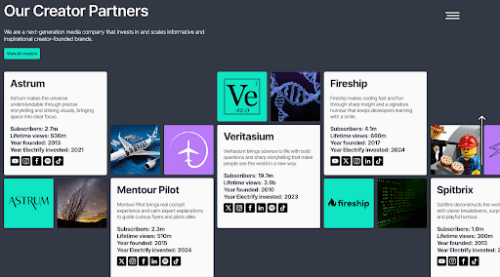 Figure 3 – Electrify Video Partners, a private equity firm responsible for the takeover of channels such as Veritaserum and more (Electrify Video Partners, 2021).
What is especially worrying in this respect is that as big corporations become more powerful, consumer welfare appears to only fall further and further. In the MIT Press-published book titled “The End of Ownership,” two Cambridge Law professors lament that we as a society are losing our right to possess and control content and devices. As a result, we are losing our “sense of self-direction, that our behaviour reflects our own preferences and choices rather than the dictates of some external authority” (Perzanowski & Schultz, 2016).
Striking evidence of this is the increase in subscription models for apparently every aspect of society. In January of this year, it was announced that Tesla would no longer sell its Full Self-Driving (FSD) software outright and would now solely offer this service through monthly subscription fees (Bove, 2026). Such a fee now sits at $149 AUD a month, whereas before March 31st, this feature could be purchased permanently for an upfront fee of $10,100 AUD (Stopford, 2026).
Meanwhile, Tesla is not the only vehicle company who have implemented subscriptions to either complement or replace a previously one-time purchase. As of August 2025, Volkswagen offered customers an “optional power upgrade” for cars in their ID.3 range, charging £16.50 per month or £165 annually to unlock the maximum horsepower of the vehicle (McMahon, 2025). Similarly, outside of Australia, General Motors (GM) offers a feature labelled “super-cruise,” a hands-free driver assistance technology. Here, customers have access to this feature for 3 years with the purchase of a GM vehicle, but after this trial period, they must pay $25 USD per month for continued access. On top of this, they now also charge monthly subscriptions for in-car internet access and many safety features. Overall, such an emphasis on subscription-based services has resulted in GM generating over $2 billion USD from April 2025 to January 2026 in subscription fees (Shimkus, 2026).
 Figure 4 – GM expects buyers to pay $135 USD for premium features per month (Stumpf, 2022).
The reality is, the majority of car manufacturers are now moving towards this subscription-based model to access technological components within their vehicles. Specifically, BMW, Toyota, Audi, Ford, Honda, Mazda, and numerous other car brands have now all implemented such features, and as cars become increasingly software-dependent, the extent to which subscriptions are implemented can only be expected to grow.
However, such subscription-based services are, of course, not limited to automotives, where a very similar phenomenon is also occurring in the media industry. Notably, as of 2023, Disney announced it would stop selling physical DVDs and Blu-ray Discs in Australia and New Zealand, a decision that can be attributed to the steep decline in DVD and Blu-ray sales over the last decade, contrasting the exponential growth of streaming service revenue (Adgate, 2023).
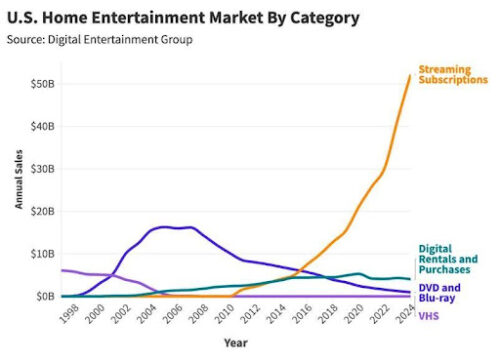 Figure 5 – Streaming subscriptions have surged in recent years compared to the fall of traditional media consumption methods (Parris, 2025).
This has left streaming services like Netflix and Disney+ with significant dominance over the media industry, where such market power was underscored in 2025 when Netflix announced the removal of its ‘Basic’ ad-free subscription, being replaced with the ‘Standard with ads’ plan (Williams, 2025). Specifically, this development harshly contrasted Netflix’s original brand proposition, which promised an ad-free viewing experience. In fact, in 2020, Netflix CEO Reed Hastings even directly claimed that “We want to be the safe respite where you can explore, get stimulated, have fun, enjoy, relax — and have none of the controversy around exploiting users with advertising” (Spangler, 2020). With all this thrown away now, however, Netflix is now aiming to generate $3 billion USD in ad revenue in 2026, after generating $1.5 billion USD in 2025 (Brooklier, 2026). Against this backdrop, Australians must now pay $20.99 AUD per month to avoid ads, which is $8 AUD more per month to stream movies or shows ad-free than it was prior to the removal of the ‘Basic’ plan.
Outside of where people spend, it is also important to examine the trajectory of working culture in Australia. In general, Australia has maintained a reputation for having a relatively relaxed work-life balance. However, people are gradually working more hours, and yet are increasingly struggling to live comfortably (ABS, 2025). According to a study in 2024, a person needs to make around $130,000 a year in order to afford the price of a standard rental unit (Burgess, 2025). If we are moving towards a society that revolves around maximising profits, this is not only generated from making people spend more but also from making them work more.
Internationally, the rise of late-stage capitalistic characteristics provides a cautionary example for Australians. In Japan, the principle of Karoshi – death from being overworked – is a real phenomenon, where the Japanese government is currently introducing reforms to stop unpaid overtime work and low wages that have exacerbated this problem (Santillanes, 2023). However, this rigorous work culture has bled into the social network of the country, where ‘Konbini’ dining is a common option for salary workers who do not have time to cook or socialise, with there being a convenience store for every 2,200 people in Japan (Goto, 2026). Moreover, in South Korea, the Chaebol system is a conglomerate structure that controls 60% of exports, despite 90% of workers working for small or medium-sized businesses. Here, companies within this system include Samsung and Hyundai, which are controlled by a single-family dynasty (Kenton, 2025). Finally, in America, the top 10% of earners are spending more than ever while the other 90% has cut their spending. Thus, the US economy is essentially sustained on a fraction of the population, allowing it to neglect the majority (Ensign, 2025).
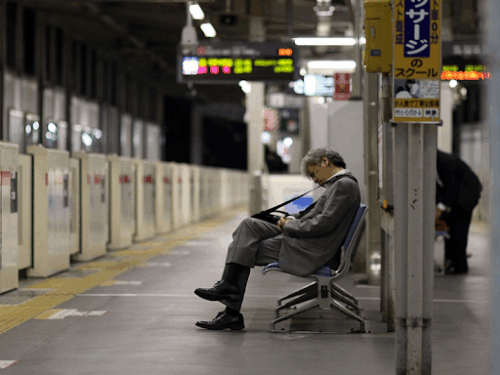 Figure 6 – Karoshi represents a major problem in Japanese working culture and work-life balance (Matsangou, n.d.).
Alongside this, as the price of goods increases, the quality, meanwhile, has generally decreased, which can largely be attributed to access to cheap materials and overseas labour. In this regard, major companies such as Apple, Nike, and Google use offshore manufacturing to cut labour costs (Kelly, 2024).
Specifically within the fast fashion industry, Australia is one of its largest consumers, averaging 56 new items of clothing a year, but only at an average cost of $13 AUD, far lower than most countries (The Australian Institute, 2024). In 2022, the ready-made garment industry contributed 10.2% of Bangladesh’s total workforce, mostly for international fast fashion companies (Chen, 2026). On this note, we are currently entering a time where the role of people, especially amongst countries in the global south, is to produce goods and labour for large companies to profit from by selling to people in wealthier countries, presenting a somewhat exploitative supply chain.
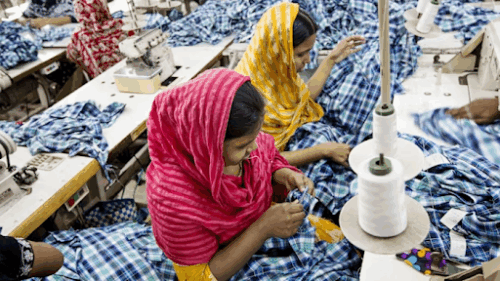 Figure 7 – Bangladesh has a significant portion of its workforce employed in producing fast fashion products (Weinland, 2018).
Worryingly, corporate consolidation has also outpaced the checks and balances against it. Whilst the ACCC supermarket inquiry made 20 useful suggestions, including mandatory pricing transparency, stronger supplier protections, and increased enforcement funding, it notably fails to break up the structural powers of the Woolworths-Coles duopoly (ACCC, 2025). In terms of labour, however, the new right to disconnect and the increased minimum wage signal a pushback against the exploitative features of late-stage capitalistic work culture. While these regulatory changes are new and their efficacy is still being debated, it generally indicates a step towards a better direction.
To prevent the worsening of monopolies in Australia, there needs to be the introduction of competition back into the market and security for labourers to ensure universal engagement and growth in the economy. Overall, the increase of corporate power has infiltrated many aspects of everyday life, down to our entertainment, transport, and our everyday necessities. Consumerism and wealth disparities are higher than ever, and are not voluntary. As people lose their everyday freedoms to endless work and advertisements, whilst being perceived as increasing convenience, more and more of society seems to resemble an oligarchy. Without intervention, this will only worsen.
The CAINZ Digest is published by CAINZ, a student society affiliated with the Faculty of Business at the University of Melbourne. Opinions published are not necessarily those of the publishers, printers or editors. CAINZ and the University of Melbourne do not accept any responsibility for the accuracy of information contained in the publication.