The National Disability Insurance Scheme (NDIS) was one of the most ambitious social reforms in Australia’s history, designed to provide tailored lifetime support to individuals who live with permanent and significant disabilities. Today, the system itself is the one in desperate need of support, overrun with scams and fraudulent providers.
Australia’s disability support before the NDIS was “underfunded, unfair, fragmented and inefficient”, prompting The Australian Productivity Commission to raise an Inquiry Report in 2011 addressing the future of disability support in Australia. (Prod Com) laying the foundation of the NDIS which was later introduced in 2013. The idea was to create a funding scheme as “a core function of the government like Medicare,” moving away from one-size-fits-all welfare towards a more personalised approach that best meets each participant’s needs.

Source: Australian National Audit Office
The NDIS first came into effect in July 2013 in four trial sites being the Hunter Region in NSW, Barwon region in Victoria, for South Australians up to 14 years old and Tasmanians between 15 and 24 years old. By August 2017, the scheme grew to 100,000 people, and reached 200,000 people by September 2019. By July 2020, the NDIS officially became a national scheme, also recording 391,999 people receiving supports. As of April 2026, the scheme has a total of 761,442 active participants nationally, serving approximately 1 in 40 Australians.
Such a transformation has genuinely benefitted thousands of in need Australians and their families, however, it is leaving a significant fiscal footprint. The NDIS is the fastest growing area of government expenditure, expected to grow in spending by 4.1% annually from 2023 to 2034 (Aus Soc Serv). The NDIS is funded by the Commonwealth and all states and territories. In the first year of the scheme in FY2013-14, expenditure was reported to be $130.9 million, with a funding envelope provided of $148.8 million. Once the scheme began a full rollout nationally, expenditure exploded to over $1 billion, with the Commonwealth Government contributing $638.8 million. Such accelerated growth in participants and need for funding continued to grow, with costs surging to over $46.3 billion in FY 2024/25. The Commonwealth Government has footed a majority of these costs, raising their funding by AU$3 billion YoY to $33.5 billion while state governments provided $11.6 billion.
However, costs have far surpassed original estimates by the Productivity Commission in 2011, where it was estimated that a fully-developed scheme for 410,000 people would cost $13.5b, growing at a rate of 3-6% per year. Today, with expenditure already at capacity, the NDIS is expected to grow at a rate of 10% annually until 2035, where it will serve over 1 million people for a cost of $95.76 billion, roughly 2.1% of GDP.
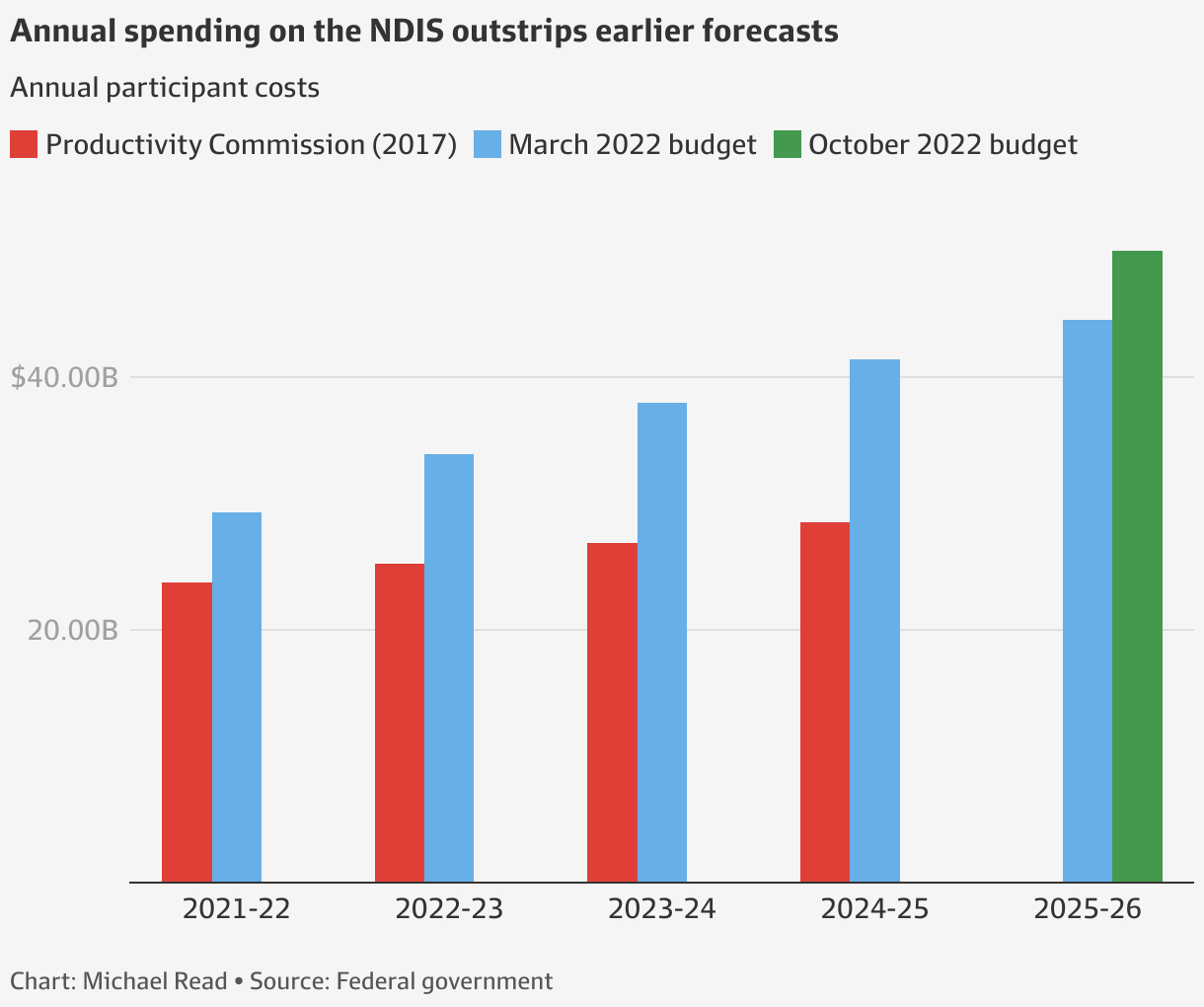
Consistent underestimated forecasts leads to regulatory oversight (Source: Federal Government)
Participant demand is also growing, with an “annual rate of over 10%” (NDIS). The program was created with the best intentions in mind; however, the system’s integrity is being exploited without tangible consequence, with “almost a third of NDIS payments going to just 5% of participants” (Grant). As expenditure outpaces oversight, gaps emerge in the system which enable loopholes costing taxpayers and people in need billions of dollars.
There are over 280,000 NDIS providers, however only 6% are registered and subject to regulation. This is due to registration being voluntary, with registered providers being subject to audits while being visible to regulators, meaning that little is known about unregistered providers with limited ability to oversee their operations. Scandals involving the misuse of NDIS funding have steadily increased, with perpetrators ranging from sole or small providers to larger organisations. In 2021, a Victorian man was jailed for creating fake bookings for house and yard maintenance that participants of the program never requested, and that he never performed, collecting more than $342,000 for lavish personal use. Another case involves Australia’s Specialist Disability Accommodation (SDA) program, part of the NDIS, where more than $100 million of investment funds intended to improve housing for people of severe disabilities were misused for gambling, crypto, luxurious items by developers at Alammc Developments in August 2025. Around $78 million were reported to be vanished, with a further $36 million lost in similar schemes, leaving many retirees and small investors out of pocket while very few homes were actually built.
Fraud has even stepped into the mainstream pop culture, with popular YouTubers Pete Z and Drew Pavlou uncovering a “$4.6b disability fraud scheme” in the Western Sydney Area, finding previously shut-down businesses operating under a new name amongst an artificially high number of NDIS providers. The investigation alleged that providers charge a 50% to 500% mark-up over retail prices for products, with the pair being met with physical assault and legal threats in the video. NDIS misuse also has roots in organised crime. In December 2022, a New South Wales man was sentenced to three years in prison for his role in a western Sydney crime syndicate by having facilitated the withdrawal of over $2.2 million in illicit funds across three companies linked to fraudulent NDIS claims.
Sydney NDIS provider director accused of $3.6m fraud (Source: ABC News)
The loosely regulated NDIS funding has raised serious concerns for vulnerable individuals who genuinely depend on these services, with chief executive of National Disability Services representing providers Michael Perusco claiming that unregistered providers providing services such as grocery shopping could charge the same rates as a registered professional delivering complex therapy.
Given the growing scrutiny within the NDIS’s scheme, the government has undertaken significant reforms to limit one of its fastest-growing expenditure areas and to tighten the verification process through increased auditing and more structured verification process while still maintaining fairness to those who have genuine need for such support. In the 2025-26 Federal Budget, the government allocated an additional $151 million over four years for the NDIS’s Crack Down on Fraud program, continuing enhancements to the fraud detection IT systems. As these reforms are still being rolled out, their full outcomes are yet to be assessed. However, key measures include fraud control, new pricing arrangements, and tightened eligibility rules, reflecting focuses on stricter governance to balance flexibility with accountability. With tighter regulations and more detailed pricing structures in place, Australians can expect significant reductions in exploitative business profiting from the scheme.
The implementation of the NDIS has significantly improved access to tailored supports services and enhanced the quality of life for many Australians with disabilities. However, the rise of widespread fraud and misuse in recent years also reflects a wider issue in uncapped and claim-based government programs, arising from rapid expansion, early-stage oversight, and trade-offs of flexibility for scale. In response to misconduct by both service providers and participants, the government, aside from limiting annual cost growth to around 8%, is introducing new frameworks within the scheme. These reforms aim to improve governance, strengthen fraud control, tighten verification processes and introduce new pricing structures to ensure long-term financial sustainability while preserving the core principle of supporting individuals with genuine needs.
Sources
https://www.ndis.gov.au/about-us/history-ndis
https://www.ndis.gov.au/media/8281/download?attachment
https://www.ndis.gov.au/publications/annual-report/annual-report-2019-20
http://ndis.gov.au/publications/annual-report/annual-report-2015-16
https://www.abc.net.au/news/2026-04-21/everything-you-need-to-know-about-the-ndis/106566022
https://www.abc.net.au/news/2026-04-19/ndis-unregistered-providers-6b-savings-price-reform/106571188
https://www.abc.net.au/news/2026-04-19/ndis-unregistered-providers-6b-savings-price-reform/106571188
https://www.pc.gov.au/inquiries-and-research/disability-support/report/ (Prod Com)
https://www.abc.net.au/listen/programs/am/millions-vanish-in-disability-housing-scandal/105692316
https://budget.gov.au/index.htm
https://www.ndis.gov.au/about-us/improving-integrity-and-preventing-fraud/crack-down-fraud
https://www.government.nl/topics/care-and-support-at-home/applying-for-a-personal-budget
The CAINZ Digest is published by CAINZ, a student society affiliated with the Faculty of Business at the University of Melbourne. Opinions published are not necessarily those of the publishers, printers or editors. CAINZ and the University of Melbourne do not accept any responsibility for the accuracy of information contained in the publication.