With a few clicks, millions of Chinese can earn an income. We are witnessing how technology is redefining the way the next generation of China’s workforce materialises. App-based platforms have streamlined everyday services into instant job opportunities, blurring the line between employment and on-demand labour. However, beneath the praised convenience of China’s mushrooming gig economy lurks the grim truth of depending on work that is as flexible as it is fragile.
The gig economy is a labor market where individuals engage in short-term, flexible work often facilitated by digital platforms (Shanghai BenCham, 2024).
The Chinese gig economy is known as the biggest in the world, boasting over 200 million participants, more than a hundred times the gig workers in Australia (Yao, 2024). It all began in the 1980s with Deng Xiaoping’s economic reforms, which encouraged self-employment and rural entrepreneurship, a shift that deepened into the early 2000s as rapid urbanisation drew millions from rural areas into cities and this coupled with mass layoffs from state-owned enterprises pushed workers to seek alternative sources of income (Shanghai BenCham, 2024). The state moved to formalise this direction through Premier Li Keqiang’s “Internet Plus” strategy in 2015, which promoted innovation and entrepreneurship through digital technologies. This led to rapid expansion of e-commerce which further accelerated demand for gig services, and the sector grew into a multi-billion dollar industry, with the food delivery market alone expanding from £2.4 billion in 2011 to an estimated £75 billion by 2024 (Shanghai BenCham, 2024).

Figure 1: Chinese food delivery workers. Source: The Economist
China’s gig economy spans several distinct sectors. The most dominant are platform delivery, led by Meituan and Ele.me who collectively control over 80% of China’s food delivery market, and ride-hailing services led by Didi (Shanghai BenCham, 2024). The scale of these platforms is massive, Meituan alone recorded 7.45 million active delivery riders in 2023 (Left Renewal, 2025). Demand on the consumer side is just as remarkable, with over 1.8 million food delivery orders placed daily in Beijing alone (Shanghai BenCham, 2024). Not to mention the emergence of a rapidly growing segment of gig workers operating in live-streaming commerce, selling products in real-time to millions of viewers through platforms such as Douyin and Taobao Live (Chen, 2024).
China’s urban youth unemployment rate reached an alarming 21.3% in June 2023, a figure so unprecedented the government had temporarily stopped publishing it (The OWP, 2025). Such a high youth unemployment rate has pushed many well-educated graduates towards the gig sector, alongside middle-aged workers laid off from economic downturns and rural migrants looking for work opportunities (Yao, 2024). With a record 12.2 million students expected to graduate in 2025, analysts warn that these new graduates will push the unemployment rate up, possibly leading to an even greater influx of workers into an already saturated gig economy (The OWP, 2025; Left Renewal, 2025).
Often framed as a provider of autonomy and flexibility, China’s gig economy masks a far harsher reality — one where choice is an illusion and participation is deemed a necessity. Influenced by high barriers to entry to and scarce opportunities of traditional jobs, alongside rising cost-of-living pressures, gig work has shifted from temporary side-hustles to becoming a survivalistic means to an end for migrant workers and university graduates alike.
Citizens, moving from rural areas to larger cities in hopes of greater employment opportunities, continue to be undermined by China’s hukou system — a registration policy established in the 1950s that ties individuals to their birthplace. Once acting to control overpopulation in urban areas, it now limits the educational opportunities, financial support and labour rights of these migrant workers (Zhang, 2009). Meituan and Didi — leading platform-based companies of the gig network — who specialise in delivery services and ride hailing respectively, have lowered the barriers of entry into urban labour markets. This has unnecessitated the formal education that many rural citizens lack, along with providing an immediate income source that is unachievable under arduous hiring processes for permanent jobs. Naturally, the low wages that accompany this quick money has to be further compensated by longer work hours; a mechanism to offset financial insecurity. O
n average, migrant labourers work 53.4 hours weekly with nearly 40% logging more than 60 hours (Liu et al., 2025). This coupled with the psychological pressure of maximising service orders under productivity-driven AI algorithms severely compromises the physical and mental health of migrant workers. In particular, the most alarming figure may be the 12,000 e-bike traffic accidents involving delivery riders across the country in 2023 (South China Morning Post, 2026). Given migrant workers’ limited access to health insurance and social protections, it reinforces the systematic discrimination endured by this vulnerable group. 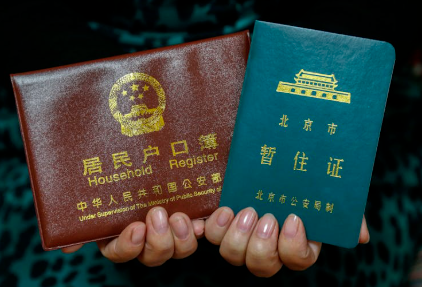
Rural hukou document (left) and Beijing temporary residence permit (Source: (The Conversation)
The struggle of securing permanent employment is a shared feeling for fresh graduates too, where gig work has become an attractive, yet involuntary, alternative to a stable professional career, perceived to be out-of-reach. China’s economic slump has decreased demand for labour resources, whilst structural shifts have exposed a considerable mismatch between graduates’ skills and the needs of China’s evolving, innovation-led economy. The former largely suits their past manufacturing-reliant economy, whereas the latter increasingly values proficiency in programming, automation and data analytics (Shi, 2024). This combination of cyclical and structural factors, respectively, has amplified the labour market’s competitiveness. As a result, the saturation of jobseekers in white-collared jobs, namely finance and humanities, has left graduates opting for flexible work, leaving their degrees astray. Issues associated with underemployment extends beyond a short-term inefficient allocation of labour resources. Long-term implications involve graduates forgoing early-career progression opportunities, like mentorship and professional development, critical for long-term human capital growth. As a record 12.7 million graduates are set to flood the job market in 2026 (Zuo, 2025), will they endure to fight for a traditional career pathway or embrace the flexibility — and insecurity — of gig work?

Graduates at a two-day job fair in China’s Hunan province. (Source: Global Times)
Essentially, China’s gig economy represents more than the casualisation of labour. It is also a reflection of the underlying structural problems associated with outdated government policies and an increasingly competitive labour market, placing a strain on sustainable growth of the economy.
What began as a digital side-hustle has swollen into something closer to national infrastructure: a job machine supporting more than 200 million people and rewiring the labor market from a neat, upward ladder into a tangled, frantic web (The Economist, 2025). Now that the sector is too large to ignore—and arguably too big to fail—Beijing faces a tricky question with no painless answer: how to regulate a market this huge without snapping the flexibility that keeps it moving?
So far, the state has reached for a scalpel, not a sledgehammer. Rather than forcing platforms to treat every courier like a full corporate employee—an expensive fix that could sink the very apps supplying these jobs—policymakers are experimenting at the edges. Think pilot injury-insurance schemes, targeted compliance rules, and hybrid legal categories that sit somewhere between contractor and staff member (International Labour Organization, 2026). It is a controlled gamble. Move too quickly and costs could smother the industry; move too slowly and the social consequences could spill into something far messier.

China’s food delivery industry (Source: Washington Post)
For workers, though, the celebrated “freedom” of gig life can feel less like independence and more like a slow-burn squeeze. Behind the convenience of hot meals in 20 minutes is a workforce carrying a heavy psychological load: more than half report constant anxiety about unstable earnings, and nearly 42% are operating with no real safety net at all (The Business Times, 2026). This is risk reallocation on a massive scale. Firms are not so much hiring people as they are purchasing tasks, then quietly shifting the complications of healthcare, injury, and retirement off their books and onto individuals. The pay story is just as lopsided as the headlines suggest. Yes, a relentless rider in Shanghai can sometimes out-earn an office worker—at least in a good week. But the upside is fragile, and the distribution is brutal. For every rider who hits a streak, there are far more stuck below 4,000 yuan a month, grinding long hours for uncertain returns (Left Renewal, 2025). In practice, a living wage starts to look like a lottery rather than a right. And while the gig boom may flatter GDP totals, the deeper effect has been to thin out workers’ bargaining power and widen wage dispersion across the workforce (Applied Economics, 2026; Wang, 2025).
Most unsettling, perhaps, is the rise of the “invisible manager.” In this world, workers do not answer to a supervisor—they answer to software. Algorithms assign jobs, rate performance, track routes, and squeeze minutes until safety becomes negotiable and time feels permanently short (Australian Institute of International Affairs, 2024). As China pushes to lead in AI, the gig economy has become one of its biggest live-fire testing grounds. The question ahead is not only about wages or legal categories. It is whether a modern economy can be built where workers remain human beings—not just moving dots on a map, optimized relentlessly in pursuit of a five-star rating.
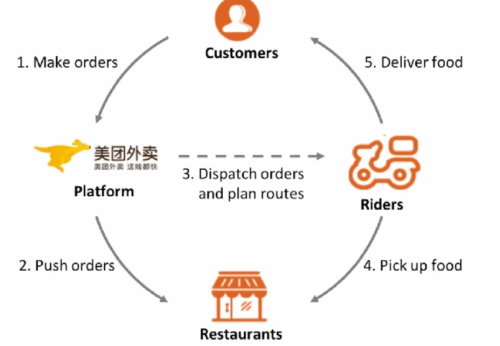
Online food delivery service of Meituan platform (Source: Research Gate)
China’s gig boom is no longer a temporary fix for economic cooling; it is a fundamental structural shift in the nature of work. While its scale and algorithmic efficiency offer a vital lifeline for millions, they also deepen systemic inequality and redistribute risk to the vulnerable. Ultimately, the survival of this model depends on whether China can pivot from hyper-optimization to a sustainable framework that prioritizes human dignity over five-star ratings.
Reference
Applied Economics. (2026). Gig economy expansion and wage effects in China. https://www.tandfonline.com/doi/full/10.1080/00036846.2026.2614495
Australian Institute of International Affairs. (2024). The human costs of China’s gig economy. https://www.internationalaffairs.org.au/australianoutlook/the-human-costs-of-chinas-gig-economy/
Chen, J. (2025). View of Overview of China’s Live Commerce Market: Douyin Case Study. [online] Drpress.org. Available at: https://drpress.org/ojs/index.php/HBEM/article/view/26358/25884.
International Labour Organization. (2026). Beyond employees and contractors: Mapping China’s platform-based gig workers. https://www.ilo.org/resource/article/beyond-employees-and-contractors-mapping-china%E2%80%99s-platform-based-gig-workers
Left Renewal. (2025). The gig economy era in China. https://leftrenewal.org/articles-en/chuang-keeping-each-other-afloat-3/
Left Renewal (2025). The Gig Economy Era [in China]: The Saturation of the Employment Reservoir, New Regulations Incite Controversy – 17 September 2025 – Left Renewal Blog. [online] Leftrenewal.org. Available at: https://leftrenewal.org/articles-en/chuang-keeping-each-other-afloat-3/.
Liu, D., Dong, H., & Gao, H. (2025). The gig treadmill: Urban-rural exclusion and the overwork of China’s couriers. Cities, 167, 106358. https://doi.org/10.1016/j.cities.2025.106358
Shi, T. (2024). The Economic Implications of Skill Mismatch in China’s Labor Market: A Focus on Higher Education Graduates. Law and Economy. 3(10), 30–38. https://www.paradigmpress.org/le/article/view/1370
Shanghai BenCham (2024). China’s Gig Economy: Key Data and Insights | BenCham Shanghai. [online] Bencham.org. Available at: https://shanghai.bencham.org/news/chinas-gig-economy-key-data-and-insights.
South China Morning Post. (2026, March 22). Why is the gig economy sweeping China? [Video]. YouTube. https://www.youtube.com/watch?v=GVUrreAon7A
The Business Times. (2026). How China’s growing gig economy has left a generation adrift. https://www.businesstimes.com.sg/international/global/how-chinas-growing-gig-economy-has-left-generation-adrift
The Economist. (2025). China’s 200m gig workers are a warning for the world. https://www.economist.com/leaders/2025/09/18/chinas-200m-gig-workers-are-a-warning-for-the-world
The Economist (2021). The gig economy challenges China’s state-run labour unions. [online] The Economist. Available at: https://www.economist.com/china/2021/01/27/the-gig-economy-challenges-chinas-state-run-labour-unions.
The OWP (2025). As More Earn Degrees, Fewer Find Jobs: China’s Employment Gap Widens. [online] The Organization for World Peace. Available at: https://theowp.org/reports/as-more-earn-degrees-fewer-find-jobs-chinas-employment-gap-widens/.
Wang, J. (2025). Gig economy and its impact on employment. https://www.nature.com/articles/s41599-025-05970-x
Yao, C. (2024). The Human Costs of China’s Gig Economy – Australian Institute of International Affairs. [online] Australian Institute of International Affairs. Available at: https://www.internationalaffairs.org.au/australianoutlook/the-human-costs-of-chinas-gig-economy/.
Zhang, H. (2009). The Hukou system’s constraints on migrant workers’ job mobility in Chinese cities. China Economic Review, 21(1), 51–64. https://doi.org/10.1016/j.chieco.2009.10.002
Zuo, M. (2025, November 21). China braces for record 12.7 million graduates entering tight job market in 2026. South China Morning Post. https://www.scmp.com/economy/china-economy/article/3333652/china-braces-record-127-million-graduates-entering-tight-job-market-2026?module=inline&pgtype=article
The CAINZ Digest is published by CAINZ, a student society affiliated with the Faculty of Business at the University of Melbourne. Opinions published are not necessarily those of the publishers, printers or editors. CAINZ and the University of Melbourne do not accept any responsibility for the accuracy of information contained in the publication.