A grueling four-year wait. An eight-year sporting spectacle in the making. A two-month countdown about to commence. With the entire football community having their eyes fixed on June 11th, the 2026 FIFA World Cup has been designed to break records and redefine the scale of global sporting events. With 3 host nations and 2 months left, it all comes to a standstill for 1 shared love for football.
Long before the world stopped spinning every four years for a month of goals and heartbreak, the World Cup’s precursor was the Olympic football tournament, recognized by FIFA in 1914. However, because the Olympic Games were mostly for amateurs, they fell short of the scale and standard that modern football demanded. The turning point came in 1928, when the incumbent FIFA president Jules Rimet proposed the idea of a standalone international championship designed to stitch a fractured world back together through the shared language of the pitch, which laid the foundations of the modern World Cup.
Since that historic decision, the tournament no longer excluded the world’s elite professional players, allowing it to rapidly evolve in both quality and scale. From having a total of 13 participants in the inaugural edition in the “Switzerland of the Americas”, World Cup had expanded to 16 nations by 1934, further to 24 nations in 1982 and 32 nations in 1998. The trajectory continues as it balloons to a staggering 48 teams for the 2026 campaign, the largest in the tournament’s history. This was an initiative to provide more opportunities for countries to be a part of football’s biggest stage and reinforce its status as the world’s most anticipated sporting event.

Football’s most coveted prize, now a collector’s piece (Source: FIFA Collect)
Equally unprecedented is FIFA’s decision to award hosting rights jointly to the United States, Mexico, and Canada, the first time three nations will share the role. With 104 matches scheduled in just over a month, demands of infrastructure, transport, and logistics have grown beyond the capacity of a single host. By spreading the tournament across North America, FIFA is leaning on a ready-made playground of elite stadiums, a “low-risk, high-reward” strategy rather than high-risk construction projects: an issue that ultimately weakened Morocco’s competing bid.
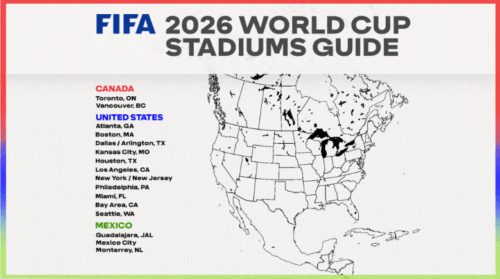
2026 World Cup Stadiums Map (Source: MLS Soccer)
For supporters, this tri-nation format offers a unique blend of culture unlike any before. One can watch a match in Los Angeles before cruising the Pacific Coast, explore Mexico City’s ancient landmarks while enjoying authentic tacos al pastor, or experience Vancouver’s stadium energy before escaping into breathtaking mountain landscapes by evening. It is going to be a month-long marathon of goals and grandeur, where the only thing harder than picking a winner will be deciding between a poutine, a taco, or a hot dog.
Undoubtedly, the 2026 FIFA World Cup will be a prime pedestal for boosting economic activity in hosting countries. It is projected to contribute an unprecedented 40.9 billion USD to GDP globally. However, underneath the idealistic picture that governments and media paints about the tourism frenzy, employment haven and infrastructure investment lies unforeseen geopolitical shocks, substantial financial risks and inescapable economic liabilities.
North America has been orchestrated to be the hotspot destination for this summer. To accommodate the influx of visitors, businesses will be compelled to hire more labour, which nurtures a fertile hub for job creation in accommodation, hospitality, transport and retail industries. It is the golden opportunity for host countries to advertise on an international stage, leaving an unforgettable tourism legacy and returning foreign visitors long-term. In theory, the World Cup is expected to revitalise domestic demand and fully sweep hotel occupancies, but US geopolitical tensions have planted an unwavering obstacle for the tourism sector just months out from the world-class tournament. Whilst interstate spectators are wounded with a $4-per-gallon, gas station bill, overseas supporters suffer from intercontinental flights that have catapulted up 148%. There is also a risk of the“crowding-out” effect, where ordinary tourists are deterred from visiting host cities, which heavily stems from perceptions of limited accommodations, fears of high travel costs and avoidance of rowdy football fans. Thus, the combination of geopolitical unrest and tourist displacement, introduces a possibility of falling short from the 1.24 million-visitor benchmark.
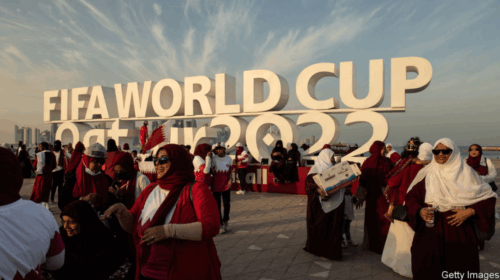
Tourists at most recent FIFA World Cup Qatar 2022 (Source: The Economist)
Avoiding the “white elephant” burden, the 2026 edition intends to utilise 16 pre-existing sporting complexes for the entertainment of 104 matches. This is a lesson learnt from its predecessors, such as Brazil’s Arena Amazonia, which cost $230 million to build, yet only used for 4 matches. Due to its remote location, post-2014 World Cup utilisation has been minimal; an empty stadium with no clear long-term purpose, leaving the government unnecessary, ongoing maintenance costs with negligible economic return. Despite no new builds this time round, there is still high government expenditure required to upgrade facilities that meet the high standards of a world-class event. This includes: transport improvements, along with enhanced on-pitch lighting and audio systems. Again, offering short-term employment and stimulating activity for local economies.
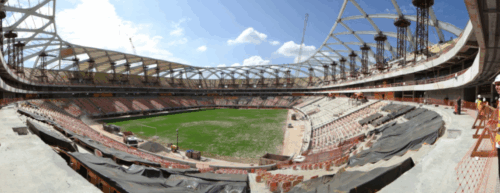
Construction of Brazil’s Arena Amazonia (Source: Amazon Aid)
Yes, the numerics are staggering. On paper, this is the pinnacle of global sport. Yet the existence of inflated economic forecasts, geopolitical uncertainty and persisting government costs leaves the question: will the World Cup deliver an admirable economic legacy, or merely a short-lived spectacle with lasting economic strain?
The United States’ role as a primary host nation has led to significant geopolitical issues, with Iran’s participation serving as the most prominent example.
In December 2025, the US denied visas to five members of Iran’s delegation for the World Cup draw, including Football Federation president Mehdi Taj, with Iran stating that the denials had “nothing to do with sport”. This extended to the players themselves, with star striker Mehdi Taremi potentially facing visa denial due to past military service and a deleted social media post.
Most incriminating of all, with all US visa processing for Iranian nationalities fully suspended as of January 2026, Iranian supporters have no viable path to attend their own team’s matches.
The situation escalated further when US and Israeli military strikes hit Iran in February 2026, leading to Iran’s Sports Ministry banning all club and national teams from travelling to hostile countries, casting serious uncertainty on Iran’s participation in the World Cup despite no official withdrawal being submitted to FIFA.
Iran’s participation issue is by no means an isolated case, but rather the most visible consequence of the tension between US immigration policy and FIFA’s promise of global inclusion. The Trump administration’s travel ban prohibits the entry of citizens from 19 countries to the United States, with a January 2026 decree further halting visa processing for 75 countries, directly affecting fans from qualifying nations including Haiti and Côte d’Ivoire, who may not be able to attend their own team’s matches. Moreover, proposals in the US to screen visitors’ social media for “anti-Americanism”, combined with the deployment of ICE agents across 14 US airports, threaten global inclusivity and risk creating an unwelcoming atmosphere that extends far beyond banned nations to international visitors of all backgrounds. This raises serious doubts over whether the 2026 World Cup can genuinely uphold FIFA’s founding promise that football unites the world.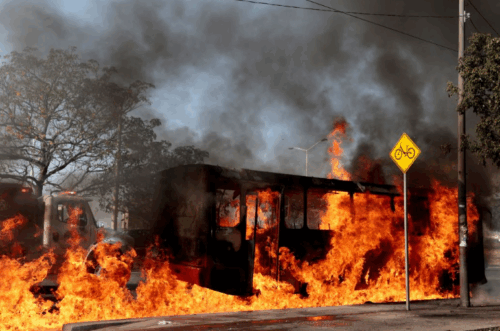
Mexico Cartel Warning (Source: CNN World)
These concerns are not limited to the United States alone. In Mexico, the killing of cartel leader “El Mencho” in February 2026 triggered widespread violence across the country, including in cities scheduled to host World Cup matches, prompting Mexico to deploy nearly 100,000 security personnel to ensure the safety of the tournament.
The 2026 World Cup promises to be the biggest ever, yet bigger does not always mean better. As commercialisation grows and geopolitical tensions intensify, FIFA must align its appetite for growth with its founding promise of global inclusion. Ultimately, a tournament that claims to unite the world must first ensure that the world is genuinely welcomed.
Sources:
https://thepfsa.co.uk/the-first-world-cup/
http://edition.cnn.com/2012/07/22/opinion/greene-olympics-amateurs
https://www.fifa.com/en/tournaments/mens/worldcup/articles/number-teams-every-edition
https://time.com/4629939/fifa-world-cup-teams-48-2016/
https://www.oxfordeconomics.com/resource/world-cup-set-to-kick-off-us-inbound-travel-rebound/
https://brockpress.com/visa-dispute-strains-us-iran-world-cup-plans/
https://www.ynetnews.com/sport/article/rjvfhxkzzg
https://tripballs.now/guides/wc2026/fans/iran
https://www.cfr.org/articles/the-u-s-is-co-hosting-the-world-cup-but-much-of-the-world-cant-attend
The CAINZ Digest is published by CAINZ, a student society affiliated with the Faculty of Business at the University of Melbourne. Opinions published are not necessarily those of the publishers, printers or editors. CAINZ and the University of Melbourne do not accept any responsibility for the accuracy of information contained in the publication.