On 21st of September 2026, before the market opened, Nike was removed from the S&P 100 after 18 years on the index. This comes as a result of Nike’s significant drop off from its 2021 peak, with its market capitalization falling roughly 78% since. Replacing it were Dell, Palo Alto Networks, Arista, and SanDisk, four companies built upon AI infrastructure. Investors must now question whether Nike can recover, and if this change signifies problems solely associated with Nike or a market-wide shift.
Nike’s fall from the S&P 100 wasn’t triggered by a single event, but rather the accumulation of mistakes over the last 5 years. However, before these mistakes are examined it is important to note that revenue has actually risen by a modest 4% since 2021 (Sahoo, 2026). Whilst this increase is uncharacteristic of a business that would seek to sustain or increase its market control, the real problem from an income statement perspective is the amount Nike have spent to realise this marginal increase in revenue, with net income dropping by 46%. Ironically, one of these mistakes was one driven by the goal to increase profit margins. John Donahoe, Nike’s former CEO, was hired in 2020 to evolve Nike into a company that focused on direct sales primarily through digital channels. This decision resulted in major investments, with Nike acquiring firms such as Datalogue, Zodiac and Celect and heavily financing and relying upon the Nike and SNKRS apps. Donahoe’s strategy was very much a bet on long term growth following major short-term investments.
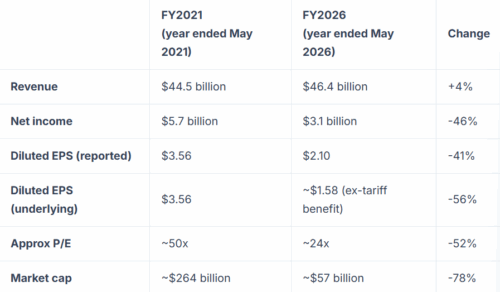
Figure 1: Nike financial comparison table
However, the belief that “retailers needed Nike more than Nike needed them,” (Parkes-Hupton, 2026) did not only cost Nike in terms of major cash investments. At the time of cutting off ties with many of these stores, leaving their shelves empty, there were competitors that had broken into the sports attire and sneaker market that were looking to further grow market share. Two of these competitors, On and Hoka, had a combined revenue of AUD$682M at the time of Nike abandoning these stores. Last year, that revenue had risen to AUD$3.2B. Additionally, soccer superstar Kylian Mbappé leaving Nike’s partnership after being with the brand since he was only 9 (Axelrod & Scherzer, 2026), to begin a partnership with On further signifies the growth of these competitors. Nike left the door wide open for them when abandoning wholesalers, something that current Nike CEO Elliot Hill is trying to correct. Another explanation for Nike’s fall is its decrease in market share in China, with its revenue falling by 12% in just the final quarter of last year (Horney & Scherzer, 2026). This has come as a result of domestic brands gaining ground, such as Li-Ning with their USD$400M sponsorship deal with Stephen Curry (ESPN, 2026). This captures the fact that Nike is slowly losing its grip in overseas markets.

Figure 2: Kylian Mbappé leaves Nike partnership to sign with On
Nike’s fall isn’t a one-off. It points to a bigger question facing premium and sportswear brands right now: is having a well- known name enough to keep customers buying? Increasingly, the answer seems to be no. LVMH, the world’s biggest luxury group and owner of Louis Vuitton, Dior, and Tiffany, has fallen out of Europe’s top 10 most valuable companies for the first time since 2017, with its stock down about 55% from its 2023 peak (Modaes, 2026). Its revenue grew only 1% at constant exchange rates in the first quarter of 2026, amid weak demand in China, conflict-driven disruption in the Middle East, and even a consumer backlash in China over a trademark dispute involving Louis Vuitton have all chipped away at its value (Zhu Wenqian, 2026). Hermès shows the other side: its first-half revenue grew 6.1% at constant exchange rates with a 41% operating margin (Chowdhry,2026), because its scarcity-based model means demand isn’t driven by the logo alone. Adidas shows a comeback: record second-quarter sales, up 14%, came from performance products like running and football, not just its heritage name (Adidas Group, 2026).
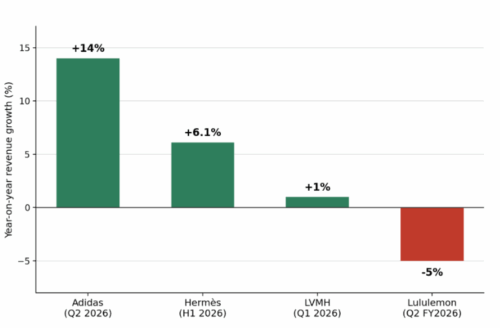
Figure 3: Latest Reported Revenue Growth of Four Major Brands (Constant Currency)
Note. Reporting periods differ: Adidas Q2 2026, Hermès H1 2026, LVMH Q1 2026, Lululemon fiscal Q2 2026. Data from Adidas Group (2026), Chowdhry (2026), Modaes (2026), and Lululemon Athletica Inc. (2026).
The clearest case study is Lululemon, which faces two problems at once. First, its sales are falling. Last quarter, revenue dropped 4% to $2.4 billion (5% at constant currency), with the Americas, its biggest market, down 8% (Lululemon Athletica Inc, 2026), trading below $100 for the first time since 2018% (Jagielski, 2026). The causes are mainly about product and competition. Legging sales fell 20% as customers shifted towards looser fits, some new products got a weaker response than planned, and rivals like Alo Yoga and Vuori have been winning customers (Fatima, 2026) Lululemon also faces a reputation risk. The Texas Attorney General is investigating whether its clothing contains PFAS, or “ forever chemicals,” which have been linked to a higher cancer risk (Burbach and Watson, 2026) Lululemon says it does not use PFAS, and experts note that skin absorption is a minor exposure. route, so there is no proof its leggings cause harm (Lululemon, 2026a). However, because Lululemon sells itself as a wellness brand, even doubt about safety can damage the trust that justifies its premium prices. In summary, as Figure 1 shows, growth varies sharply even among well-known brands. These brands show that a famous name only holds its value when it is backed by fresh products, genuine desirability and customer trust.
Nike’s removal from the S&P 100 has forced investors to reassess whether the company represents a compelling value opportunity or a business facing deep structural challenges. Although Nike remains one of the world’s most recognizable sports brands, investors must weigh its lower valuation against weakening financial performance and declining brand momentum.
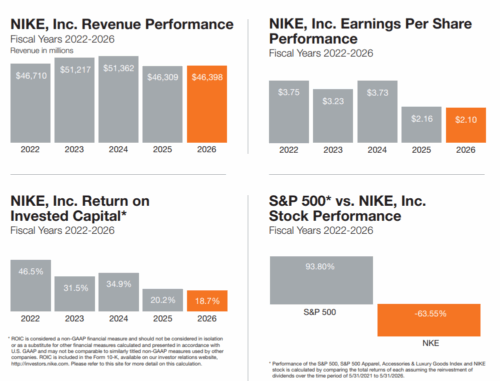
Figure 4: Nike CEO Letter p.3
Nike has seen a significant decrease in its P/E ratio from February of 2026 40.90 to now 17.2 (Companies Market Cap, 2026). This decline reflects reduced investor confidence in Nike’s potential growth. On a whole the clothing industry has seen a drop from February 30.75 to now being 14.7 (Companies Market Cap, 2026). Nike’s P/E ratio remains above the industry average, suggesting investors still assign value to its brand strength, cash generation, and recovery potential. But the decrease in the premium indicates the market’s distrust of whether Nike can restore margins and regain market share, particularly in China where Nike had sales drop 21% in 2nd quarter (Reuters, 2025). Nike currently offers a dividend yield of approximately 4.59% with annual dividend payments of around US$1.5 billion which is covered with the free cash flow (FCF) of US$2.2 billion (Nike, 2026).
Profitability remains a major concern. In 2024 Nike had a gross margin of 44.6% and for FY2026 Nike reported 42.9% (Nike, 2026). Although Nike reported a 49% gross margin in Q4 2026, tariff recovery payments inflated the result (Nike, 2026). Adjusting for the tariff repayment, actual Q4 gross margin was approximately 40%. Falling margins suggest that it is struggling to clear inventory and requires discounting to help stimulate demand. Additionally Nike has seen a decrease in earnings per share and return on invested capital (Nike, 2026).
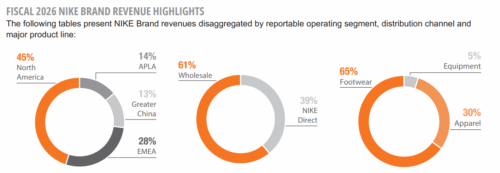
Figure 5: Nike Form 10-K p.33
China currently represents a significant challenge for Nike, representing 13% of revenue while revenue shrinks (Nike, 2026). The brand reported declining store traffic, elevated promotional activity and excess inventory in China, all of which pressured profitability and are expected to weigh on results through fiscal 2027 (Nike, 2026). Overall, Nike’s financial recovery depends on management’s ability to successfully rebuild margins and stabilise growth in China. Nike’s brand represents significant value, but newer competitors such as Li-Ning, Hoka, On, and Lululemon have captured significant market share and have established a culture around themselves. The depressed valuation could offer substantial upside, however if pressures continue to weaken the margins, the current valuation may accurately reflect a company facing long-term structural challenges.
Nike’s removal from the S&P 100 is a symptom of its decline. Years of strategic missteps, margin pressure, weakening demand, and rising competition drove the company from one of America’s most prestigious indexes. Yet Nike remains one of the world’s most valuable sportswear brands, supported by a global presence and resilient financial position. Its path back to growth depends on restoring product innovation, rebuilding market share in China, and recapturing the entrepreneurial spirit the company was founded on. Whether Nike returns to the S&P 100 will depend on its ability to execute these changes.
Adidas Group (2026). Adidas Group. [online] adidas. Available at: https://www.adidas-group.com/en/media/press-releases/adidas-grows-top-line-14percent-and-achieves-record-sales-in-q2
Axelrod, B., & Scherzer, L. (2026). Kylian Mbappé leaves Nike for on as brand launches soccer division. Front Office Sports. https://frontofficesports.com/article/kylian-mbappe-leaves-nike-for-on-as-brand-launches-soccer-division/
Burbach, E. D and Watson, D.E. (2026). Texas attorney general investigates Lululemon over alleged “forever chemicals” in activewear. What this signals for consumer products, apparel, and wellness brands. [online] Foley & Lardner LLP. Available at: https://www.foley.com/insights/publications/2026/04/texas-attorney-general-investigates-lululemon-over-alleged-forever-chemicals-in/
Chowdhry, A. (2026). Hermès: H1 2026 revenue reaches €8.2 billion as operating margin holds at 41%. [online] Pulse 2.0. Available at: https://pulse2.com/hermes-h1-2026-revenue-reaches-e8-2-billion-as-operating-margin-holds-at-41/
CompaniesMarketCap. (n.d.). Nike (NKE) P/E ratio. CompaniesMarketCap. Retrieved September 28, 2026, from https://companiesmarketcap.com/nike/pe-ratio/
ESPN. (2026). Sources: Stephen Curry signs $400m deal with China’s Li-Ning – ESPN. ESPN. ESPN.Com. https://www.espn.com.au/nba/story/_/id/48940127/stephen-curry-signs-chinese-sportswear-company-li-ning
Fatima, M. (2026). Lululemon’s (LULU) brand problems force another steep guidance downgrade. [online] Yahoo Finance. Available at: https://finance.yahoo.com/markets/stocks/articles/lululemon-lulu-brand-problems-force-161627412.html
Horney, B., & Scherzer, L. (2026). What Nike’s ‘embarrassing’ s&P 100 exit really means. Front Office Sports. https://frontofficesports.com/article/what-nikes-embarrassing-sp-100-exit-really-means/
Jagielski, D. (2026). Lululemon Stock Falls to $100: Has it become a bargain buy? [online] Yahoo Finance. Available at: https://www.fool.com/investing/2026/09/14/lululemon-stock-falls-to-100-has-it-become-a-bargain-buy/
Lululemon (2026a). Created without PFAS: What to know about lululemon’s products. [online] Lululemon.com. Available at: https://corporate.lululemon.com/newsroom/our-stories/2026/created-without-pfas-what-to-know-about-lululemons-products
Lululemon Athletica Inc (2026b). Lululemon Athletica Inc. announces second quarter fiscal 2026 results. [online] Lululemon.com. Available at: https://corporate.lululemon.com/newsroom/press-releases/2026/09-03-2026-210528733
Modaes (2026). LVMH loses stock-market weight, drops out of Europe’s top 10 as luxury cools – modaes global. [online] Modaes. Available at: https://www.modaes.com/global/companies/lvmh-loses-market-value-and-falls-out-of-the-top-ten-in-europe-as-the-luxury-market-slows
Nike, Inc. (2026). Nike, Inc. 2026 shareholder letter. https://s1.q4cdn.com/806093406/files/doc_financials/2026/ar/Nike-Inc-2026-Shareholder-Letter.pdf
Nike, Inc. (2026). Nike, Inc. Form 10-K for fiscal year 2026. https://s1.q4cdn.com/806093406/files/doc_financials/2026/ar/Nike-Inc-2026-10K.pdf
Parkes-Hupton, H. (2026). ‘Diluted’: Key errors behind Nike’s collapse. news.com.au — Australia’s leading news site for latest headlines. News.Com.Au. https://www.news.com.au/finance/business/retail/sportswear-giant-nike-booted-from-sp-100-after-319-billion-value-collapse/news-story/9efddab5d60107c98f8c64397a287aee
Reuters. (2025, December 19). Nike’s China conundrum deepens as turnaround stagnates, shares slump. Reuters. https://www.reuters.com/business/retail-consumer/nikes-china-conundrum-deepens-turnaround-stagnates-2025-12-19/
Sahoo, A. (2026). Why is Nike being removed from S&P 100? Vested Finance. https://vestedfinance.com/blog/us-stocks/why-is-nike-being-removed-from-sp-100/
Zhu Wenqian (2026). Louis Vuitton shuts down another store amid fallout from trademark dispute in China. [online] South China Morning Post. Available at: https://www.scmp.com/business/china-business/article/3365041/louis-vuitton-shuts-down-another-store-amid-fallout-trademark-dispute-china
The CAINZ Digest is published by CAINZ, a student society affiliated with the Faculty of Business at the University of Melbourne. Opinions published are not necessarily those of the publishers, printers or editors. CAINZ and the University of Melbourne do not accept any responsibility for the accuracy of information contained in the publication.