A new chapter in US-China Relations
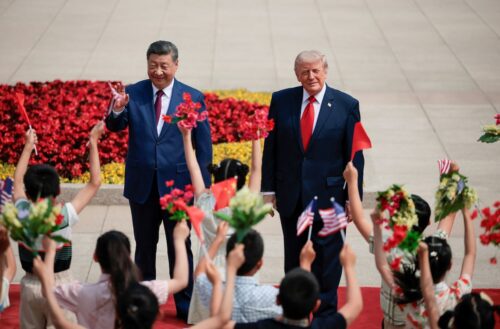
Figure 1: Children waved Chinese and American flags in a choreographed welcome, The Globe and Mail
‘China has been ripping us off for years’. For much of the past decade, Donald Trump framed China as America’s greatest economic rival. Yet, during his May 2026 visit to Beijing, the same president was standing inside the Great Hall of the People in Beijing, telling Xi that US-China ties are going to be ‘better than ever’. The sudden shift in tone highlighted the importance of the Beijing summit at a time when tensions over trade, technology, military influence, and Taiwan had pushed relations to a critical point.
While the summit did not erase the deep rivalry between Washington and Beijing, it marked an important attempt to stabilise relations between the world’s two most powerful nations. The meetings suggested that both sides recognised the dangers of continued confrontation and the need for greater communication and cooperation moving forward.
Political tension over the arms sale to Taiwan
One of the clearest signs that tensions remained unresolved after the Beijing summit was the issue of American arms sales to Taiwan. Even before Air Force One touched down in Beijing, Donald Trump told reporters that he intended to discuss US weapons sales to Taiwan directly with Xi Jinping, casually remarking that ‘President Xi would like us not to’. This statement immediately alarmed Taiwan and US allies in the Indo-Pacific region, as Washington has historically considered arms sales to Taiwan non-negotiable and requiring no Beijing approval. Trump’s public linking of this issue to the summit negotiations appeared to place a long-standing US security commitment on the negotiating table.
At the centre of the controversy was a proposed $14 billion weapons package for Taiwan, including missiles and air defence interceptors. The Trump administration had delayed the sale for months. China strongly opposed the sale, viewing it as interference in its internal affairs. At the summit, Xi Jinping warned that mishandling the Taiwan issue could lead to conflict between the two countries. He also stated that stable relations were possible if Washington respected China’s position. This statement, combining pressure and diplomatic manoeuvring, reinforced Taiwan’s place in Beijing’s foreign policy.
Figure 2: Donald Trump participating in a friendship walk through Zhongnanhai Garden with Chinese leader Xi Jinping in Beijing. NYTimes
Trump’s response deepened uncertainty. Rather than reaffirming America’s traditional support for Taiwan, he avoided committing to the weapons package and stated only that he would make a decision ‘over the next fairly short period’. While he stopped short of changing official US policy, the summit revealed a noticeable shift in tone. For decades, the United States has presented itself as Taiwan’s most reliable security partner. After the summit, however, America’s commitment appeared less certain and reliable, raising concerns that Taiwan could become a bargaining chip in the broader US-China relationship.
Planes Were a Tool for Geopolitical Leverage
Historically, China’s Boeing orders have indirectly conveyed the state of US-China relations. From 2015 to 2017, China placed an average of 127 orders per year with Boeing for use within Chinese airlines such as Air China, China Southern, and Hainan Airlines — making it one of Boeing’s most important markets. However, the next few years took a drastic turn. In 2018, Trump began a trade war with China, causing Chinese Boeing orders to halt. In 2019, two fatal crashes caused by design issues led Boeing’s bestselling 737 Max to be grounded by global aviation regulators. The COVID-19 pandemic in 2020, which significantly impacted air travel, only further exacerbated the order drought, as China failed to follow through on their pledge to
purchase $77 billion in US-made goods. The mix of geopolitical and commercial pressures left Chinese airlines averaging just 6 airplanes a year.
The summit in May appeared to break the drought. Trump stated that China agreed to order at least 200 and up to 750 commercial aircraft from Boeing, along with roughly 400 to 450 General Electric engines. China later additionally announced that both the US and China would work towards extending the tariffs truce they previously agreed on in October and seek tariff cuts on $30bn or more of goods each. This was clearly a deal not negotiated through ordinary commercial channels but made at the highest political level, highlighting how planes act as political currency for China.
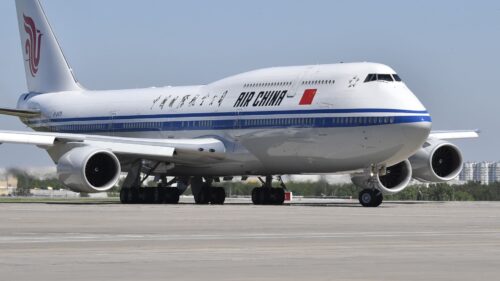
Figure 3: A Boeing plane owned by Air China. Source: CNBC
While the 200-plane order signalled a restoration of diplomatic relations between the US and China, investors did not receive this news well. A lack of details surrounding aircraft types, timing, and delivery schedules caused uncertainty amongst investors. The 200 planes fell short of analysts’ expectations of a 500-plane order, causing Boeing shares to fall over 4% following the announcement. Moreover, Boeing’s debt position remains concerning for investors, holding only $10.9 billion in cash against $53.8 billion in long-term debt by the end of Q4 in 2025.
Whether the 200-plane commitment ever hardens into a formal contract, or whether the 750-plane order will eventually happen, will ultimately depend less on Boeing’s order books than on the political relationship it was designed to symbolise. For now, the deal is best understood as a diplomatic handshake expressed through a commercial agreement.
100th Anniversary Speech
Xi Jinping in 2021 said it plainly, standing in Tiananmen Square for the Communist Party’s 100th anniversary. Anyone who tries to bully, oppress or enslave China ‘will be crushed to death before the Great Wall of steel built with the flesh and blood of over 1.4 billion Chinese people’.
Five years later, Trump was sitting across from Xi in the Great Hall of the People. The tone had changed, the position had not.
Xi in his statements reserved his sharpest language for Taiwan, calling it ‘the most important issue’ in the bilateral relationship. He warned Trump that mishandling Taiwan may lead to ‘clashes and even conflicts’, and even urged Washington to ‘exercise extra caution’ around arms sales to the island. While Trump did not reaffirm America’s commitment to the island, he said he would decide ‘over the next fairly short period’.
For Taiwan, that ambiguity was the story.
The $14 billion weapons package remains in limbo. A package that nine consecutive administrations treated for granted is now, apparently, negotiable. Taiwanese officials had already expressed concerns and anxiety about being ‘on the menu’ in Trump-Xi talks. After the summit, that anxiety had not been relieved.
The other unresolved fault line was technology.
The summit revealed the minimal progress made on the most consequential dimensions of US-China competition: AI, cyber operations, exports, and digital sovereignty. Nvidia CEO Jensen Huang flew to Beijing with a presidential delegation. Two leaders announced a bilateral AI dialogue. No timeline was given. No framework was agreed
Operations done by China, including Volt Typhoon’s reported breach of US critical infrastructure and Salt Typhoon’s surveillance of telecommunications network, was identified in the 2026 Annual Threat Assessment as the ‘most active’ and persistent threat facing the United States. None of this was substantively addressed at the summit.
Rather than resolution, the meeting in Beijing created stability. The gap between the short summit agenda, and the long listed issues between the nations engaged in grinding and competition reveals a shared preference for managing their rivalry rather than resolving it.
This distinction matters. A relationship that is managed instead of resolved can easily be re-priced the very moment conditions change. For this reason, only time can tell whether the summit was truly significant or if the stability it promised is a temporary reprieve — a pause that holds only until the next point of friction forces both sides back to the questions Beijing left unanswered.
https://abcnews.com/Politics/theyre-ripping-us-off-trumps-long-standing-grievance/story?id=120447216
https://en.yenisafak.com/world/trump-tells-xi-us-china-ties-can-become-better-than-ever-3718268
https://apnews.com/article/trump-xi-china-iran-trade-a1d63a711a037472f5c1c330c2120bd5
https://www.taipeitimes.com/News/front/archives/2026/05/21/2003857699
https://www.brookings.edu/articles/thinking-through-americas-baseline-priorities-on-taiwan/
https://www.nytimes.com/2026/05/14/world/asia/trump-china-photos.html
https://www.japantimes.co.jp/commentary/2026/05/19/world/boeing-china-deal/
https://www.bbc.com/news/articles/c98rjydlgp4o
The CAINZ Digest is published by CAINZ, a student society affiliated with the Faculty of Business at the University of Melbourne. Opinions published are not necessarily those of the publishers, printers or editors. CAINZ and the University of Melbourne do not accept any responsibility for the accuracy of information contained in the publication.