Will Jesus Christ return before 2027? What will Donald Trump say this week? Prediction markets have exploded from a niche novelty to a mainstream financial instrument, transforming everything, from politics to pop culture, into tradable events – but what are prediction markets and why have they become so prominent yet problematic?
But how can we be 97% sure that the Son of God will not return? Instead of traditional shares, “event contracts” are traded tied to specific outcomes on future events representing the collective belief about the likelihood of a specific outcome. Each event is turned into a simple “Yes/No” financial contract, paying $1 if it occurs and $0 if it doesn’t. The price traders are willing to pay for that contract becomes that market’s implied probability. As information emerges, traders act on their own private valuation, aggregating the collective views of participants with a financial incentive to be right, transforming opinions into price.
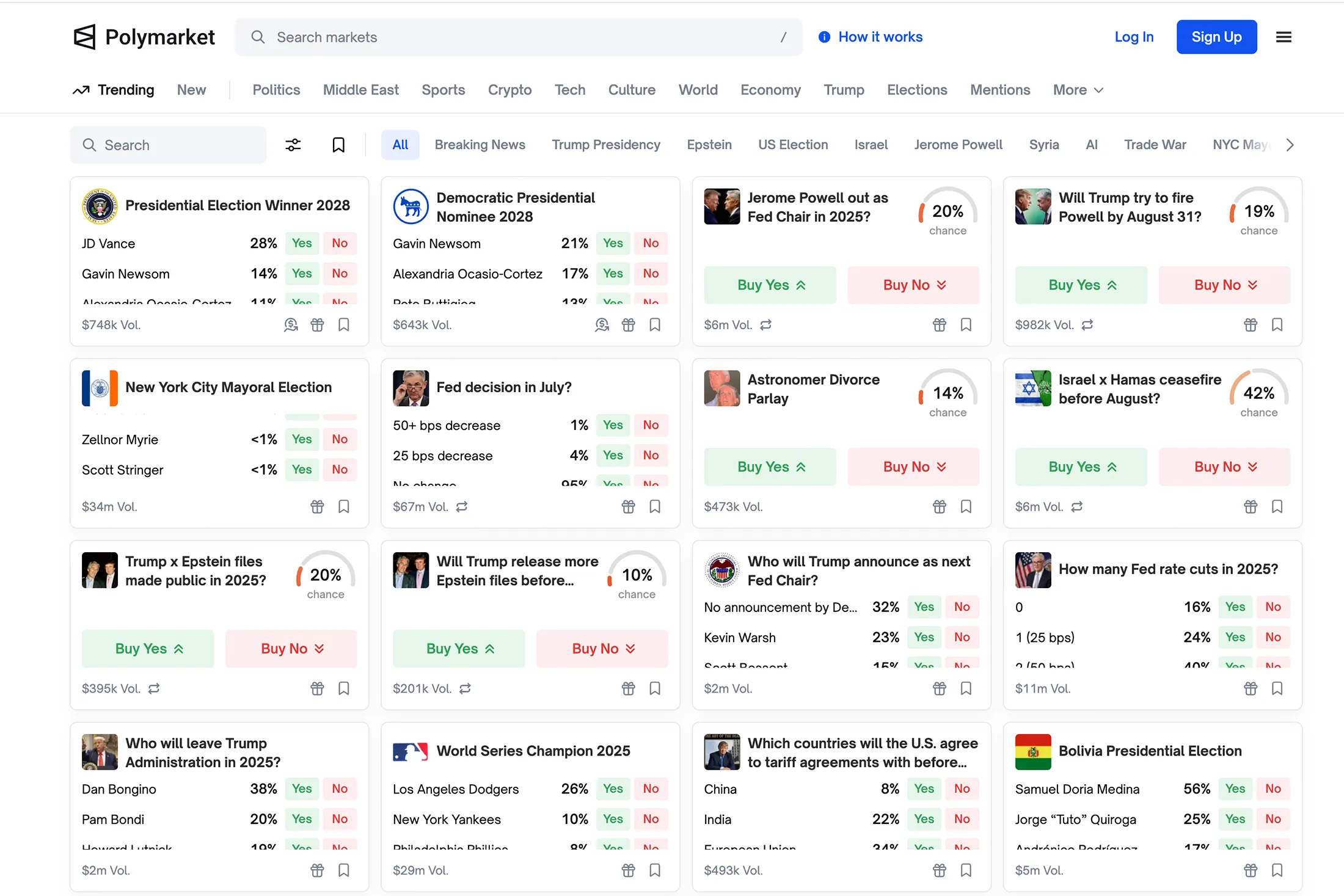
Various markets offered by prediction giant Polymarket (Source: Bloomberg News)
Such accessibility quickly gained traction among millions, driven mainly through platforms such as Kalshi (2018) and Polymarket (2020), each seeking valuations in excess of US$20 billion. Fuelled by Kalshi’s successful appeal of the CFTC’s 2023 prohibition on listing election outcome contracts, both premier sites processed a combined $4.7 billion USD worth of trades during the 2024 US election alone, garnering global attention.
Sports have also contributed heavily to the rise, with Kalshi reporting over $1 billion in trading volume during Super Bowl LX. Major sporting organisations followed, with the MLB also adopting prediction markets, announcing Polymarket to be their “exclusive Prediction Market Exchange partner” in March 2026. Two of America’s largest sportsbooks FanDuel and DraftKings have also left the American Gambling Association to pursue opportunities in prediction markets. Major news outlets CNN and CNBC have also started to incorporate prediction markets to reflect market sentiment through a partnership with Kalshi, while Polymarket has partnered with The Wall Street Journal. Even Donald Trump Jr. is reportedly a paid advisor to Kalshi, with Trump Media announcing plans for its own prediction market platform, Truth Predict, allowing users to “trade prediction contracts on major events… such as political elections.”

Kalshi at the Superbowl (Source: Paulick Report)
In the United States, prediction markets capitalise on being treated as “financial products” by the Commodity Futures Trading Commission (CTFC), enabling them to operate in a relatively less regulated environment compared to traditional gambling. Sportsbetting is only available in 38 states for users 21 and older, while prediction markets are legal in all 50 states and available to users aged 18 and over, despite sportsbetting accounting for 85% of total market liquidity on Kalshi. In August 2025, Australia banned Polymarket, determining the platform to be an illegal gambling service and in breach of the Interactive Gambling Act by the Australian Communications and Media Authority.
Before 2020, the speculative market remained niche, with platforms such as PredictIt operating under restricted regulation, with a ceiling limit of USD$850 and a small user base. From 2024 to 2025, total trading volume exploded by 400%, growing to approximately $44 billion, led by $21.5 billion on Polymarket and $17.1 billion on Kalshi. Favourable regulatory standing, decentralised trading methods, and heightened demand for participation in high-stakes political and economic events are all major contributors to this meteoric rise.
Polymarket CEO Shayne Coplan went on record in a 60 Minutes interview labelling the markets as “the most accurate thing we have as mankind right now.” Understandably, this statement has sparked extensive criticism and controversy in light of the operator’s reluctance to address insider trading, as well as concerns around unethical incentives and questionable business structures.
Prediction markets are often regarded as outperforming polls or expert forecasts due to real-money incentives that enhance the accuracy of “crowd intelligence”, a concept popularised by Galton’s Ox experiment, where each participant brings their valuation based on access to information, creating a web of predictions that ultimately produces a live probability of an outcome. Keyrock & Dune produced a recent report that gauged the accuracy of prediction markets using the Brier score, a metric used to measure probabilistic binary outcomes with lower scores meaning higher accuracy. Overall, sports betting commonly has a score of 0.18–0.22, while the best economic forecasters sit around 0.20–0.25. In comparison, Kalshi and Polymarket have average scores of 0.09, lending credibility to Coplan’s assessment.

Source: Keyrock, Brier.fyi
However, only 30% of traders earn positive profits with consistent performance over time, while the remaining 70% lose money. The top 1% of users capture 84% of all trading gains, an extraordinarily concerning concentration of profit, suggesting that, despite being framed as information markets, prediction markets could be less accessible to average participants and are consistently being dominated by highly informed insider traders. This issue has raised concerns around regulation, information asymmetry and whether prediction platforms should be classified as financial instruments or illicit gambling.
Unlike regulated platforms such as Kalshi that require identity verification and operate under stricter oversight, decentralised crypto-based blockchain technology enables anonymity. This creates an environment where individuals with non-public information can trade undetected by splitting their bet across multiple wallets to conceal identity. As a result, these markets may resemble an “insider market” where outcomes reflect not only public expectations, but also privileged information.
Although many cases are still alleged and legal, questions must be raised regarding specific wagers on major geopolitical events. For example, the capture of former Venezuelan President Nicolás Maduro returned US$436,000 to an anonymous participant, while one Polymarket trader “Magamyman” profited US$553,000 on well-timed bets just before an Israeli strike killed Supreme Leader Ali Khameni, a fraction of the US$500 million worth of bets placed on the conflict. Some now-removed markets even included the use of nuclear weapons, raising ethical concerns regarding war profiteering and incentives for officials to act in favour of catastrophic events for monetary gain.
Some counterarguments, such as Robin Hanson’s paper on Insider Trading and Prediction Markets from George Mason University, suggest that insider trading has its benefits within these markets. Hanson argues, “The point of these markets is to get information… people with more information should trade more and get more money because that’s how they get paid for the information they contribute”. He also argues that “adverse selection in trading profits reduces ordinary people’s desire to trade”.
Under current regulation, prediction markets have been described as “rife with insider trading,” a concern publicised by Senator Chris Murphy, who aims to limit insider trading risks by prohibiting betting on political, military, and government events through the “Bets Off Act”. Senator Murphy accused the Trump Administration of “making a mint off corrupt prediction markets” while the White House has since “denied anyone in Trump’s orbit was behind such lucrative trades”. The inherent nature of the markets incentivise participants to trade on non-public information, ultimately creating an unfair public market.

Prediction markets sit at the controversial intersection of information and speculation. They offer a powerful tool for aggregating expectations about future events but also raise concerns about insider trading and incentives for insiders to act unethically. As these platforms continue to gain traction among both media outlets and the public, a regulatory grey area persists, specifically surrounding fairness and if they should be treated as gambling or financial instruments.
Although much of the volume is driven by sportsbetting, some other markets in politics or war events can incentivise behaviour that disadvantages less-informed irrational participants, especially when competing against better-informed or potentially insider actors. With both public popularity and regulatory scrutiny increasing, the sustainability of their future growth remains in the hands of the market.
So what do you think then?
Sources
https://arxiv.org/pdf/2508.03474
https://edition.cnn.com/2024/10/02/business/appeals-court-allows-kalshi-election-betting/index.html
https://www.cnbc.com/2026/02/10/kalshi-super-bowl.html
https://sports.yahoo.com/article/fanduel-draftkings-exit-american-gaming-133500250.html
https://news.kalshi.com/p/donald-trump-jr-strategic-advisor
https://www.wired.com/story/trump-truth-social-launches-prediction-market/
https://www.theguardian.com/us-news/2026/feb/12/prediction-markets-polymarket-kalshi-online-gambling
https://www.forbes.com/sites/willyakowicz/2026/02/26/where-is-sports-betting-legal-america-2022/
https://kpmg.com/us/en/articles/2025/current-state-of-prediction-markets.html
https://www.forbes.com/sites/boazsobrado/2025/12/16/how-prediction-markets-actually-grew-in-2025/
https://finance.yahoo.com/news/prediction-market-volume-quadrupled-past-190400921.html
https://keyrock.com/prediction-markets-report/
https://finance.yahoo.com/news/70-polymarket-traders-lost-money-192327162.html?utm
https://papers.ssrn.com/sol3/papers.cfm?abstract_id=6443103
The CAINZ Digest is published by CAINZ, a student society affiliated with the Faculty of Business at the University of Melbourne. Opinions published are not necessarily those of the publishers, printers or editors. CAINZ and the University of Melbourne do not accept any responsibility for the accuracy of information contained in the publication.