Ever since post-World War II, Japan’s economy has been characterised as a global industrial powerhouse, fueled by the role of keiretsu – a tightly connected network of large corporations partnering with each other to support stability and reduce risks. With a huge competitive advantage in producing goods, Japan chose a manufacturing-oriented economy, regarding tourism only as a secondary contributor to its growth (Hall, 2001). However, what was once a supplementary sector has now become an increasingly important driver in reshaping Japan’s role in the global economy.
Whilst many of its Asian neighbours experienced a decline in tourists post-pandemic, Japan has written its own story, alluring an influx of visitors since 2022. This divergence has been primarily driven by its unique culture, a weakening Japanese Yen, alongside a government strategy to accelerate growth in its tourism industry. The Japanese Yen falling more than 50% against the US Dollar since 2021 has piqued foreign visitors’ interest. This depreciation has been driven by astonishingly low interest rates, relative to the majority of countries, which was a necessity to stimulate economic growth after COVID-19. As a result, it has yielded many investors to look elsewhere for higher, more attractive returns. Despite Japan’s monetary policy inducing a 30-year high interest rate of 0.75% last December, low relative interest rates, coupled with weak investor confidence, have worked in favour of international visitors’ purchasing power. In 2025, the country welcomed a record of 42.7 million inbound arrivals. Increasing affordability has also bolstered tourist spending by 16.4% year on year to another record high of ¥9.5 trillion in the same year, with the tourism sector rising to Japan’s second largest export after automobiles.

Kyoto autumn colours (Source: InsideKyoto)
In spite of Japan’s current state of overtourism, the government has devised a plan to boost growth in the sector, aiming to target 60 million inbound tourists by 2030. They have primarily strategised to focus on sustainable regional development. This diversification of tourist hotspots not only counteracts the shrinking population in smaller towns and villages, providing economic opportunities, but it also helps regulate the overcrowding witnessed in urban areas. However, the government’s pursuit of its tourism growth and natural mass tourist inflow may conflict with social norms, cultural preservation and political priorities.
Attracting varying demographics, Japan harmonises both traditional and modern offerings with a distinct holiday experience all-year-round. One day could be filled with exploring the bustling streets of Shinjuku, whilst the next snapping a picture in front of the iconic Mount Fuji. Japan indeed has proved to satisfy any vacation craving. Moreover, social media’s romanticisation of Japan, coined the “Japan Effect”, describes a phenomenon where an ordinary photo is suddenly elevated when a label ‘Japan’ is attached. This trend reiterates the positive perceptions held by young digital users and the desire for many to tick this destination off their bucket list.
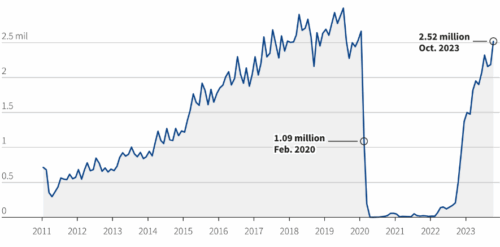
Japan’s inbound tourism trajectory since 2019 (Source: Reuters)
Since the pandemic, Japan’s tourist industry has grown to be much more than just a return of foot traffic; it is now a critical lifeline for the country’s interior. While the 2025 record of 42.7 million international arrivals is a staggering statistic, the true story lies in the “quiet” spaces—the aging shopping arcades, rural stations, and local workshops that had long been bracing for a slow decline. This revival is no longer a phenomenon exclusive to the “Golden Route” of Tokyo and Osaka. What we are seeing is a clear move toward regional growth, where tourism provides a practical lifeline for Japan’s shrinking smaller towns. A consistent stream of tourists provides these communities with more than just a financial boost; it also encourages younger residents to stay and contributes to the development of a more open, internationally connected environment.
With nearly 68% of visitors in 2024 choosing to return, Japan has moved beyond a one-time bucket list stop to become a destination people keep coming back to explore. Modern travellers are increasingly bypassing the traditional observation platforms in favour of participation. They are looking for a true “taste of place,” with over 82% drawn to regional gastronomy while also showing a renewed appetite for the country’s architectural and artisanal heritage. In Kyoto and beyond, this interest is breathing life into the landscape—restoring machiya townhouses and providing a global audience for crafts that were once on the brink of extinction. Here, culture is not a museum piece to be dusted off for a crowd; it is a living, breathing economy.
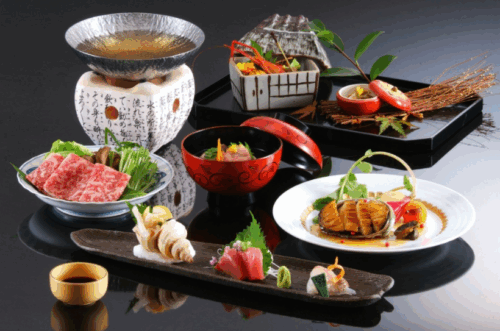
Kyoto regional cuisine (Source: Japan Travel)
Ultimately, this shift is redefining Japan’s global identity. While the iconic silhouettes of cherry blossoms and autumn maples remain the initial draw, the lasting impression for most is the seamless, almost quiet coexistence of the ancient and the hyper-modern. As visitors arrive in record numbers from across Asia and the West, they are finding a country that is both deeply rooted and increasingly accessible. This is not just a story of “movement” or “travel statistics”—it is a story of connection. Tourism is proving to be the bridge that ensures Japan’s traditions do not just survive the 21st century but thrive within it.
Japan’s government recently set an ambitious goal of 60 million visitors by 2030, nearly one and a half times the record of 42.7 million seen in 2025. Alongside this target, in an attempt to manage overtourism, authorities are rolling out aggressive interventions in the form of tripling the departure tax to ¥3,000 from July 2026. There are also further plans to introduce a pre-screening system and inspection fees for visa-free travellers, however this creates a contradiction as the very policies designed to manage overtourism act as a brake on the growth needed to meet the 2030 objectives. Stricter entry requirements and higher fees will inevitably deter some visitors, thus making it difficult to achieve the government’s dual ambition of significantly increasing tourist arrivals while making it harder and more expensive to visit.
Beyond the contradictions of Japan’s 2030 target, a deeper structural dependency was revealed in November last year. Mainland Chinese tourists were one of Japan’s largest groups of foreign visitors in 2025 at approximately 9.1 million, around 21% of all visitors. When Japanese Prime Minister Takaichi’s comments on Taiwan led to China advising its citizens against travelling to Japan, it immediately resulted in the fall of shares of Japanese tourism and retail companies. Nomura Research Institute estimated that if tension between Japan and China persists, it could result in a 1.79 trillion yen drop in Japan’s GDP in just a year. Moody’s Analytics also warned that if Chinese arrivals were to halve, as they have during previous diplomatic issues, Japan’s GDP growth could potentially shrink by up to 0.2 percentage points. This suggests that Japan has a structural vulnerability that stemmed from the fact that a fifth of its visitors comes from a single source that is vulnerable to political disruption.
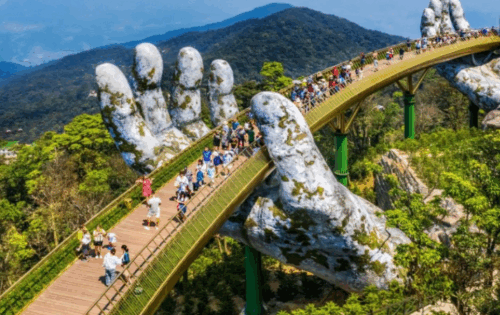
Vietnam capitalising on Japan’s geopolitical vulnerabilities (Source: Mundruy)
While Japan faces these problems, Vietnam has quietly emerged as an ever-growing competitor in the international tourism space. Vietnam reached its highest milestone in 2025, with international arrivals reaching nearly 21.2 million, up by 20.4% compared to 2024. Leading this growth was China, which contributed more than 5.3 million visitors, accounting for approximately 25% of total international arrivals, and representing a 41.3% surge compared to the previous year. This suggests that Chinese tourists who diverted away from Japan are increasingly pivoting towards Vietnam as their destination of choice.
Japan’s rapid emergence as a leading global tourism hub has been met with enthusiasm by travellers, astonishment by onlookers and scepticism by locals. This unprecedented occurrence has not only unsettled its existing cultural, social and political environment, but also redefined the nation’s economic strategy moving forward. Ultimately, sustainable growth of the sector relies on how successfully the government regulates mass tourism to fundamentally preserve a culture capturing over 15,000 years of richness and elegance.
SOURCES:
(Reference: Hall, C. M. (2001). Japan and tourism in the Pacific Rim: Locating a sphere of influence in the global economy. In D. Harrison (Ed.), Tourism and the less developed world: Issues and case studies (pp. 121–134). CAB International.)
https://www.commbank.com.au/articles/newsroom/2025/12/impact-of-japan-rate-hike.html
https://www.nippon.com/en/japan-data/h02673/
https://www.nippon.com/en/japan-data/h02681/
https://www.freetour.com/blog/how-many-tourists-visit-japan-every-year?
https://www.travelweekly-asia.com/Destination-Travel/Can-Japan-keep-up-its-tourism-boom-in-2026-
https://statistics.jnto.go.jp/en/graph/#graph–inbound–travelers–transition
https://www.cnbc.com/2025/11/18/tokyo-beijing-taikaichi-taiwan-japan-travel-gdp.html
The CAINZ Digest is published by CAINZ, a student society affiliated with the Faculty of Business at the University of Melbourne. Opinions published are not necessarily those of the publishers, printers or editors. CAINZ and the University of Melbourne do not accept any responsibility for the accuracy of information contained in the publication.